Social Security plan backed in new poll : "Most likely voters continue to support President Bush's proposal to let younger workers invest some of their Social Security payroll taxes through personal accounts, a new survey finds.
The poll by independent pollster John Zogby for the Cato Institute, which is being released today, found that when voters understood the benefits of personal investment accounts, including a better financial rate of return than the current system, the Bush plan was supported by 52 percent of Americans and opposed by 40 percent.
Among supporters, the most popular reason for supporting private accounts was, "It's my money; I should control it," Mr. Zogby said. "This was true for every group except African-Americans, who chose inheritability as their biggest reason for supporting accounts." The poll's results suggested that Mr. Bush's proposal would be much more popular if he focused "on the points in this poll," Mr. Zogby said in an interview.
"Nobody can understand or relate to the system's insolvency in 2043. But it wins a majority when the issue is raised as a matter of choice and as a positive opportunity," he said. "If it's pitted as just Social Security reform because it is becoming insolvent, that's not enough."
Wednesday, June 01, 2005


College Vouchers in Colorado
College vouchers put a face on funds in Colorado -- The Washington Times: "Recruiters for Colorado's state colleges are hustling to sign up current students and high school graduates as the nation's first market-oriented tuition-voucher system begins this fall.
Colorado is the first state to abandon direct funding to its 13 community colleges, three state universities and six other public colleges -- currently, $500 million a year -- in favor of a $2,400 tuition voucher to each enrolled college student.
'It's going to drive changes and force reform, which is what we want,' said Richard F. O'Donnell, executive director of the Colorado Commission on Higher Education (CCHE). 'Students have ownership over their tax dollars in an explicit way, which we think will motivate those changes.' "
Colorado is the first state to abandon direct funding to its 13 community colleges, three state universities and six other public colleges -- currently, $500 million a year -- in favor of a $2,400 tuition voucher to each enrolled college student.
'It's going to drive changes and force reform, which is what we want,' said Richard F. O'Donnell, executive director of the Colorado Commission on Higher Education (CCHE). 'Students have ownership over their tax dollars in an explicit way, which we think will motivate those changes.' "
Tuesday, May 31, 2005
Democrats Getting Religion
Columns: Finding religion on the left: "Listening to a Democratic meeting or political rally these days can be like attending church service. At Our Lady of Perpetual Defensiveness.
"...Howard Dean, who since becoming Democratic National Committee chairman has developed a zeal for Bible verse.
"I didn't see it in the Republican platform anywhere, but I saw in the Bible that it is easier for a camel to pass through the eye of a needle than it is for a rich man to enter the kingdom of heaven," Dean told southwest Florida Democrats recently. "It is a moral value to walk with the least among us. Those moral values are consistent with Democratic values, with American values, and they are sorely lacking with the Pharisees and the Sadducees, who preach one thing and are hypocritical. We need to kick the money changers out of the temple and restore values to America again!
Awkward as it may be at times (especially for someone such as Dean, who once called the Old Testament story of Job his favorite book of the New Testament), ...Democratic politicians have become so consumed with religion."
"...Howard Dean, who since becoming Democratic National Committee chairman has developed a zeal for Bible verse.
"I didn't see it in the Republican platform anywhere, but I saw in the Bible that it is easier for a camel to pass through the eye of a needle than it is for a rich man to enter the kingdom of heaven," Dean told southwest Florida Democrats recently. "It is a moral value to walk with the least among us. Those moral values are consistent with Democratic values, with American values, and they are sorely lacking with the Pharisees and the Sadducees, who preach one thing and are hypocritical. We need to kick the money changers out of the temple and restore values to America again!
Awkward as it may be at times (especially for someone such as Dean, who once called the Old Testament story of Job his favorite book of the New Testament), ...Democratic politicians have become so consumed with religion."
Kerry Still Running
Gainesville.com The Gainesville Sun Gainesville, Fla.: [At National Head Start Conference in Orlando]
"I went back and reread the whole New Testament the other day. Nowhere in the three-year ministry of Jesus Christ did I find a suggestion at all, ever, anywhere, in any way whatsover, that you ought to take the money from the poor, the opportunities from the poor and give them to the rich people,' Kerry said.
Kerry has yet to officially announce whether he's in the running for the 2008 nomination, and he didn't take questions from the media Friday.
But while speaking to the educators and child advocates gathered in a hotel ballroom, it wasn't difficult to imagine his rhetoric, unchanged, being said at a campaign rally.
'We need to enlist and join together in a great cause across the country that puts a simple choice before our fellow Americans. It's a choice that, I think, is based on values,' Kerry said."
"I went back and reread the whole New Testament the other day. Nowhere in the three-year ministry of Jesus Christ did I find a suggestion at all, ever, anywhere, in any way whatsover, that you ought to take the money from the poor, the opportunities from the poor and give them to the rich people,' Kerry said.
Kerry has yet to officially announce whether he's in the running for the 2008 nomination, and he didn't take questions from the media Friday.
But while speaking to the educators and child advocates gathered in a hotel ballroom, it wasn't difficult to imagine his rhetoric, unchanged, being said at a campaign rally.
'We need to enlist and join together in a great cause across the country that puts a simple choice before our fellow Americans. It's a choice that, I think, is based on values,' Kerry said."
C.I.A. in Smithfield, NC
C.I.A. Expanding Terror Battle Under Guise of Charter Flights - New York Times: "SMITHFIELD, N.C. - The airplanes of Aero Contractors Ltd. take off from Johnston County Airport here, then disappear over the scrub pines and fields of tobacco and sweet potatoes. Nothing about the sleepy Southern setting hints of foreign intrigue. Nothing gives away the fact that Aero's pilots are the discreet bus drivers of the battle against terrorism, routinely sent on secret missions to Baghdad, Cairo, Tashkent and Kabul.
When the Central Intelligence Agency wants to grab a suspected member of Al Qaeda overseas and deliver him to interrogators in another country, an Aero Contractors plane often does the job. If agency experts need to fly overseas in a hurry after the capture of a prized prisoner, a plane will depart Johnston County and stop at Dulles Airport outside Washington to pick up the C.I.A. team on the way."
When the Central Intelligence Agency wants to grab a suspected member of Al Qaeda overseas and deliver him to interrogators in another country, an Aero Contractors plane often does the job. If agency experts need to fly overseas in a hurry after the capture of a prized prisoner, a plane will depart Johnston County and stop at Dulles Airport outside Washington to pick up the C.I.A. team on the way."
Monday, May 30, 2005
France Votes No
The Times of London:
"The milestones in the evolution of Europe are well-known, from the rise of Charlemagne to the Enlightenment to the Treaty of Rome in 1957 and future scholars will agree (eventually) that yesterday's 'non' in France is a defining moment for both that country and the continent. There is something particularly ironic, perhaps unappealing, about the eccentric coalition of Left and Right that proved the campaigning engine for this monumental defeat of the French elite. And yet this unholy alliance is itself a reflection of the fundamental and fatal ambiguities of a constitution that is not worth the hundreds of pages it is written on (the exact length varies with language)...
"Far more importantly, though, the EU proceeded towards a monetary union that has so far produced pathetic economic growth, an appalling lack of competitiveness in international trade, massive unemployment, the revival of protectionism and an atmosphere in which extremists of several stripes can happily flourish. The single greatest condemnation of the EU constitution is that it promised more of the same. This fate can be reversed after this referendum. 'C'est non'is surely clear."
"The milestones in the evolution of Europe are well-known, from the rise of Charlemagne to the Enlightenment to the Treaty of Rome in 1957 and future scholars will agree (eventually) that yesterday's 'non' in France is a defining moment for both that country and the continent. There is something particularly ironic, perhaps unappealing, about the eccentric coalition of Left and Right that proved the campaigning engine for this monumental defeat of the French elite. And yet this unholy alliance is itself a reflection of the fundamental and fatal ambiguities of a constitution that is not worth the hundreds of pages it is written on (the exact length varies with language)...
"Far more importantly, though, the EU proceeded towards a monetary union that has so far produced pathetic economic growth, an appalling lack of competitiveness in international trade, massive unemployment, the revival of protectionism and an atmosphere in which extremists of several stripes can happily flourish. The single greatest condemnation of the EU constitution is that it promised more of the same. This fate can be reversed after this referendum. 'C'est non'is surely clear."
Memorial Day: IBD Comments on Media and Military
Today in Investor's Business Daily stock analysis and business news: "Memorial Day: When President Nixon replaced the draft with an all-volunteer force, anti-war rallies vanished. Now, with only volunteers serving, the anti-war crowd doesn't throw tantrums. It writes headlines.
No question much of the Vietnam era's radical left migrated to the media.
...The pettiness astounds. As President Bush told Annapolis grads Friday, over the last four years the American military has liberated some 50 million people.
But why write a macro-story when a micro-story will do?
If, as the military now fears, there's a looming recruitment problem, the elite media should bear much of the blame."
No question much of the Vietnam era's radical left migrated to the media.
...The pettiness astounds. As President Bush told Annapolis grads Friday, over the last four years the American military has liberated some 50 million people.
But why write a macro-story when a micro-story will do?
If, as the military now fears, there's a looming recruitment problem, the elite media should bear much of the blame."
Larry Kudlow on the 2005 Economy
Larry Kudlow on the 2005 Economy, GDP, and Inflation on NRO Financial: "Actually, we are looking at non-inflationary prosperity for several more years to come. This is a good stock market scenario where the broad indices still look to be 20 to 25 percent undervalued. In policy terms the Fed has done its job by restraining inflation and President Bush�s supply-side tax cuts have reignited economic growth. The results are unmistakably positive."
China to Scrap Textile Export Taxes
China to Scrap Textile Export Taxes: "Commerce Minister Bo Xilai said Washington and Brussels had failed to prove their domestic markets had been disrupted by an increase in Chinese exports since a 40-year-old system of quotas on developing countries' exports of textiles expired on Jan 1.
Bo said China was willing to hold talks, but he was scathing about the "double standards" of rich countries that flew the flag of free trade but rushed to throw up barriers when poor nations started to exploit their comparative advantage of cheap labor.
"The EU and the United States should spend more time on the development of high technology -- Airbus or Boeing airplanes, and advanced modern machinery -- rather than spending time quarrelling with us on issues like shirts, socks and trousers."
Bo was speaking hours after China said it would scrap export tariffs on 81 textile products, making good on its threat to roll back the taxes if the West imposed curbs on its goods.
The tit-for-tat move followed a formal request on Friday by the European Union for talks with China over surging shipments of T-shirts and flax yarn, which have fanned fears of widescale bankruptcies and lay-offs in the 25-member bloc.
...The row over textiles has added fuel to a debate over the value of the yuan, which has been pegged near 8.3 per dollar for a decade. Law-makers and manufacturers in the United States, as well as many independent economists, believe the peg undervalues the currency, giving China's exporters an unfair advantage.
Bo gave no clues as to Beijing's thinking on a shift in the currency, saying only that when the government decides it will consider China's needs and the stability of the global economy. "
Bo said China was willing to hold talks, but he was scathing about the "double standards" of rich countries that flew the flag of free trade but rushed to throw up barriers when poor nations started to exploit their comparative advantage of cheap labor.
"The EU and the United States should spend more time on the development of high technology -- Airbus or Boeing airplanes, and advanced modern machinery -- rather than spending time quarrelling with us on issues like shirts, socks and trousers."
Bo was speaking hours after China said it would scrap export tariffs on 81 textile products, making good on its threat to roll back the taxes if the West imposed curbs on its goods.
The tit-for-tat move followed a formal request on Friday by the European Union for talks with China over surging shipments of T-shirts and flax yarn, which have fanned fears of widescale bankruptcies and lay-offs in the 25-member bloc.
...The row over textiles has added fuel to a debate over the value of the yuan, which has been pegged near 8.3 per dollar for a decade. Law-makers and manufacturers in the United States, as well as many independent economists, believe the peg undervalues the currency, giving China's exporters an unfair advantage.
Bo gave no clues as to Beijing's thinking on a shift in the currency, saying only that when the government decides it will consider China's needs and the stability of the global economy. "
Thursday, May 26, 2005
Peggy Noonan on "Public Servants"
OpinionJournal - Peggy Noonan: "People who charge into burning towers are heroic; nuns who work with the poorest of the poor are self-denying; people who volunteer their time to help our world and receive nothing in return but the knowledge they are doing good are in public service. Politicians are in politics. They are less self-denying than self-aggrandizing. They are given fame, respect, the best health care in the world; they pass laws governing your life and receive a million perks including a good salary, and someone else--faceless taxpayers, 'the folks back home'--gets to pay for the whole thing. This isn't public service, it's more like public command. It's not terrible--democracies need people who commit politics; they have a place and a role to play--but it's not saintly, either. "
Wednesday, May 25, 2005
NC Judge Boyle in the Political Wind
newsobserver.com: "'At this point, Boyle is outside the agreement,' Tracy Schmaler, [Sen. Patrick] Leahy's committee spokeswoman, said Tuesday. 'I don't know how it affects him.'
Committee Chairman Arlen Specter, a moderate Pennsylvania Republican, said last week that Democrats, whom he didn't name, had told him they would not block Boyle.
Sen. Elizabeth Dole continues to urge her colleagues to approve Boyle's appointment.
'It's unconscionable that he has been held up this long,' said Lindsay Taylor, a Dole spokeswoman. 'He's due an up-or-down vote on the Senate floor.'
Boyle enjoys broad bipartisan support among lawyers who practice before him. The American Bar Association has rated him well-qualified for the job."
Committee Chairman Arlen Specter, a moderate Pennsylvania Republican, said last week that Democrats, whom he didn't name, had told him they would not block Boyle.
Sen. Elizabeth Dole continues to urge her colleagues to approve Boyle's appointment.
'It's unconscionable that he has been held up this long,' said Lindsay Taylor, a Dole spokeswoman. 'He's due an up-or-down vote on the Senate floor.'
Boyle enjoys broad bipartisan support among lawyers who practice before him. The American Bar Association has rated him well-qualified for the job."
Racial Preference in Education
Carolina Journal | Carolina Journal | John Hood's Daily Journal: "...it's fair to say that the best evidence leans against Bowen and Bok's thesis that lowering admissions standards for minorities has no adverse effect on their college performance, which has the additional disadvantage of being severely counterintuitive.
If preferential policies don't produce the desired result, why do college administrators and state policymakers continue to promote them? Here's where I think Gryphon really nails it. 'Affirmative action programs are the primary way that college administrators offer an institutional apology for the exclusionary policies of decades past,' she writes, so it is 'an expressive act as much as a policy decision.'
It is all about intention, in other words, and an intention that can scarcely be faulted given the racially charged history of UNC and state government in general. But good intentions don't make good laws."
If preferential policies don't produce the desired result, why do college administrators and state policymakers continue to promote them? Here's where I think Gryphon really nails it. 'Affirmative action programs are the primary way that college administrators offer an institutional apology for the exclusionary policies of decades past,' she writes, so it is 'an expressive act as much as a policy decision.'
It is all about intention, in other words, and an intention that can scarcely be faulted given the racially charged history of UNC and state government in general. But good intentions don't make good laws."
Edwards Campaigns at LSE
ABC News: The Note: Intraparty Love and Warfare: "Senator Edwards is scheduled to speak about global challenges facing the United States and Europe at the London School of Economics at 11:30 am ET."
Senator Edwards has a full schedule in his political campaign perhaps next against Senator Elizabeth Dole in a bid to return to the national platform. Oh, I forgot he is campaigning to reduce poverty on behalf of the state-funded UNC Law School.
Senator Edwards has a full schedule in his political campaign perhaps next against Senator Elizabeth Dole in a bid to return to the national platform. Oh, I forgot he is campaigning to reduce poverty on behalf of the state-funded UNC Law School.
Tuesday, May 24, 2005
Kerry's Form SF 180
The caveat emperor - The Boston Globe - Boston.com - Op-ed - News: "During an interview yesterday with Globe editorial writers and columnists, the former Democratic presidential nominee was asked if had signed Form SF 180, authorizing the Department of Defense to grant access to all his military records.
''I have signed it,' Kerry said. Then, he added that his staff was ''still going through it' and ''very, very shortly, you will have a chance to see it.'
The devil is usually in the details. With Kerry, it's also in the dodges and digressions. After the interview, Kerry's communications director, David Wade, was asked to clarify when Kerry signed SF 180 and when public access would be granted. Kerry drifted over to join the conversation, immediately raising the confusion level. He did not answer the question of when he signed the form or when the entire record will be made public...
...Kerry's communications director, David Wade, was asked to clarify when Kerry signed SF 180 and when public access would be granted. Kerry drifted over to join the conversation, immediately raising the confusion level. He did not answer the question of when he signed the form or when the entire record will be made public.
Several e-mails later, Wade conveyed the following information: On Friday, May 20, Kerry obtained a copy of Form 180 and signed it. ''The next step is to send it to the Navy, which will happen in the next few days. The Navy will then send out the records," e-mailed Wade. Kerry first said he would sign Form 180 when pressed by Tim Russert during a Jan. 30 appearance on ''Meet the Press."
Six months after Kerry's loss to George W. Bush, it feels somewhat gratuitous to point out how hard it can be to get a clear, straight answer from Kerry on this and other matters."
''I have signed it,' Kerry said. Then, he added that his staff was ''still going through it' and ''very, very shortly, you will have a chance to see it.'
The devil is usually in the details. With Kerry, it's also in the dodges and digressions. After the interview, Kerry's communications director, David Wade, was asked to clarify when Kerry signed SF 180 and when public access would be granted. Kerry drifted over to join the conversation, immediately raising the confusion level. He did not answer the question of when he signed the form or when the entire record will be made public...
...Kerry's communications director, David Wade, was asked to clarify when Kerry signed SF 180 and when public access would be granted. Kerry drifted over to join the conversation, immediately raising the confusion level. He did not answer the question of when he signed the form or when the entire record will be made public.
Several e-mails later, Wade conveyed the following information: On Friday, May 20, Kerry obtained a copy of Form 180 and signed it. ''The next step is to send it to the Navy, which will happen in the next few days. The Navy will then send out the records," e-mailed Wade. Kerry first said he would sign Form 180 when pressed by Tim Russert during a Jan. 30 appearance on ''Meet the Press."
Six months after Kerry's loss to George W. Bush, it feels somewhat gratuitous to point out how hard it can be to get a clear, straight answer from Kerry on this and other matters."
Social Class and Education
Class Matters - Social Class and Education in the United States of America - The New York Times - New York Times: "Only 41 percent of low-income students entering a four-year college managed to graduate within five years, the Department of Education found in a study last year, but 66 percent of high-income students did. That gap had grown over recent years. 'We need to recognize that the most serious domestic problem in the United States today is the widening gap between the children of the rich and the children of the poor,' Lawrence H. Summers, the president of Harvard, said last year when announcing that Harvard would give full scholarships to all its lowest-income students. 'And education is the most powerful weapon we have to address that problem.' "
This a long and important article.
This a long and important article.
Female Advantages in Business
What Women Want - New York Times: John Tierney said,"A friend of mine, a businessman who buys companies, told me one of the first things he looks at is the gender of the boss.
"The companies run by women are much more likely to survive," he said. "The typical guy who starts a company is a competitive, charismatic leader - he's always the firm's top salesman - but if he leaves he takes his loyal followers with him and the company goes downhill. Women C.E.O.'s know how to hire good salespeople and create a healthy culture within the company. Plus they don't spend 20 percent of their time in strip clubs."
Still, for all the executive talents that women have, for all the changes that are happening in the corporate world, there will always be some jobs that women, on average, will not want as badly as men do. Some of the best-paying jobs require crazed competition and the willingness to risk big losses - going broke, never seeing your family and friends, dying young."
"The companies run by women are much more likely to survive," he said. "The typical guy who starts a company is a competitive, charismatic leader - he's always the firm's top salesman - but if he leaves he takes his loyal followers with him and the company goes downhill. Women C.E.O.'s know how to hire good salespeople and create a healthy culture within the company. Plus they don't spend 20 percent of their time in strip clubs."
Still, for all the executive talents that women have, for all the changes that are happening in the corporate world, there will always be some jobs that women, on average, will not want as badly as men do. Some of the best-paying jobs require crazed competition and the willingness to risk big losses - going broke, never seeing your family and friends, dying young."
Federalist Paper No. 66 and the Deal in the Senate
Efforts of 2 Respected Elders Bring Senate Back From Brink - New York Times: "After weeks of seemingly fruitless negotiations between the two sides, Mr. Byrd, 87, a West Virginia Democrat who has spent more than half a century in Congress, and Mr. Warner, 78, a Virginia Republican who regards himself as an 'institutionalist,' met privately twice on Thursday. They parsed the language of Alexander Hamilton's Federalist Paper No. 66 in an effort to divine what the founding fathers intended when they gave the Senate the power to advise and consent on nominees. After trading telephone calls over the weekend, they drafted three crucial paragraphs.
The agreement contends that the word 'advice' in the paper 'speaks to consultation between the Senate and the president with regard to the use of the president's power to make nominations.' It goes on to state, 'Such a return to the early practices of our government may well serve to reduce the rancor that unfortunately accompanies the advice and consent process in the Senate.'"
The agreement contends that the word 'advice' in the paper 'speaks to consultation between the Senate and the president with regard to the use of the president's power to make nominations.' It goes on to state, 'Such a return to the early practices of our government may well serve to reduce the rancor that unfortunately accompanies the advice and consent process in the Senate.'"
Monday, May 23, 2005
US Senate Deal on Judges

US Senate Makes Deal

Senators Reach Deal to Avert Showdown on Judicial Nominees - New York Times: "The 14 senators who forged the compromise included, on the Republican side, Mr. McCain, Mr. Graham, John Warner, Olympia Snowe, Susan Collins, Mike DeWine and Lincoln Chafee, and on the Democratic side, Mr. Lieberman, Mr. Byrd, Ben Nelson, Mary Landrieu, Daniel Inouye, Mark Pryor and Ken Salazar.
Under the accord, announced in a hastily called Capitol news conference, the 14 senators pledged to vote to end prolonged debate on three of President Bush's most disputed appellate court nominees: Priscilla R. Owen of Texas, Janice Rogers Brown of California and William H. Pryor of Arkansas.
The 14 senators made "no commitment to vote for or against" the filibuster against two other nominees, Henry Saad and William Myers, Mr. McCain said."
AP via NYT Bias
Prodded Anew by Bush, Senate Plunges Into Marathon Debate - New York Times: "...with Republicans seeking to strip Democrats of their right to filibuster nominees to the appeals court and Supreme Court."
News story, not an op-ed - and there's no liberal bias?
News story, not an op-ed - and there's no liberal bias?
Krugman's Depression - You Heard It Here
This is what I wrote in this space early last Friday morning:
"In all economic situations, Krugman always looks for, predicts, and earnestly hopes for a depression caused by Republicans who are too foolish to just raise income taxes, sales taxes, payroll taxes, corporate taxes and use any tool to grab any assets in the hands of any entity not in poverty."
This is Krugman today:
America Wants Security - New York Times: "Here's my thought: maybe 2004 was 1928. During the 1920's, the national government followed doctrinaire conservative policies, but reformist policies that presaged the New Deal were already bubbling up in the states, especially in New York.
In 1928 Al Smith, the governor of New York, was defeated in an ugly presidential campaign in which Protestant preachers warned their flocks that a vote for the Catholic Smith was a vote for the devil. But four years later F.D.R. took office, and the New Deal began.
Of course, the coming of the New Deal was hastened by a severe national depression. Strange to say, we may be working on that, too. "
{See my post 05/20/05 7:47am: "Yuan Revaluation: Krugman Says Economists Are Confused, Proves With His Confusion".}
"In all economic situations, Krugman always looks for, predicts, and earnestly hopes for a depression caused by Republicans who are too foolish to just raise income taxes, sales taxes, payroll taxes, corporate taxes and use any tool to grab any assets in the hands of any entity not in poverty."
This is Krugman today:
America Wants Security - New York Times: "Here's my thought: maybe 2004 was 1928. During the 1920's, the national government followed doctrinaire conservative policies, but reformist policies that presaged the New Deal were already bubbling up in the states, especially in New York.
In 1928 Al Smith, the governor of New York, was defeated in an ugly presidential campaign in which Protestant preachers warned their flocks that a vote for the Catholic Smith was a vote for the devil. But four years later F.D.R. took office, and the New Deal began.
Of course, the coming of the New Deal was hastened by a severe national depression. Strange to say, we may be working on that, too. "
{See my post 05/20/05 7:47am: "Yuan Revaluation: Krugman Says Economists Are Confused, Proves With His Confusion".}
Sunday, May 22, 2005
Europe's Reality and Ours
Tomorrow (the web is a wonderful thing) IBD's editorial points out the harsh reality of Europe's future Today in Investor's Business Daily stock analysis and business news: "Europe Closing Shop?"
And today's Arizona Republic's editorial comes to the same point "European social model is limping on the runway":
After citing the statistics of "old" Europe's economic failure compared to the United States the following is the conclusion:
"In the United States, the basic choice on social policy is whether to pursue the European model and increasingly rely on the government to provide economic security, or enhance an American alternative in which individuals are more empowered to obtain economic security for themselves. The current Western European experience offers an instructive and cautionary lesson about that choice."
***************
The biggest issue facing the United States, my country as I am proud to say, is the dichotomy between two theories and as much as I try to sum up it boils down to capitalism or not, faith in God or not.
The public debates that really irritate me is first that the notion that one (I, Me) can't be a believer in economics and have a compassion for people.
The other irritation is that according to some I can't have my belief as a Catholic and still be compassionate, concerned, be an advocate for people that I disagree with, and even have a great time.
I digress and will save the remainder of this for another day.
And today's Arizona Republic's editorial comes to the same point "European social model is limping on the runway":
After citing the statistics of "old" Europe's economic failure compared to the United States the following is the conclusion:
"In the United States, the basic choice on social policy is whether to pursue the European model and increasingly rely on the government to provide economic security, or enhance an American alternative in which individuals are more empowered to obtain economic security for themselves. The current Western European experience offers an instructive and cautionary lesson about that choice."
***************
The biggest issue facing the United States, my country as I am proud to say, is the dichotomy between two theories and as much as I try to sum up it boils down to capitalism or not, faith in God or not.
The public debates that really irritate me is first that the notion that one (I, Me) can't be a believer in economics and have a compassion for people.
The other irritation is that according to some I can't have my belief as a Catholic and still be compassionate, concerned, be an advocate for people that I disagree with, and even have a great time.
I digress and will save the remainder of this for another day.
Fouad Ajami: "The Middle East Embraces Democracy --and the American President"
Today's WSJ (Online articles on Sat. & Sun.) OpinionJournal -Bush Country: "To venture into the Arab world, as I did recently over four weeks in Qatar, Kuwait, Jordan and Iraq, is to travel into Bush Country. I was to encounter people from practically all Arab lands, to listen in on a great debate about the possibility of freedom and liberty. I met Lebanese giddy with the Cedar Revolution that liberated their country from the Syrian prison that had seemed an unalterable curse. They were under no illusions about the change that had come their way. They knew that this new history was the gift of an American president who had put the Syrian rulers on notice. The speed with which Syria quit Lebanon was astonishing, a race to the border to forestall an American strike that the regime could not discount. I met Syrians in the know who admitted that the fear of American power, and the example of American forces flushing Saddam Hussein out of his spider hole, now drive Syrian policy. They hang on George Bush's words in Damascus, I was told: the rulers wondering if Iraq was a crystal ball in which they could glimpse their future...
As I made my way on this Arab journey, I picked up a meditation that Massimo d'Azeglio, a Piedmontese aristocrat who embraced that "springtime" in Europe, offered about his time, which speaks so directly to this Arab time: "The gift of liberty is like that of a horse, handsome, strong, and high-spirited. In some it arouses a wish to ride; in many others, on the contrary, it increases the desire to walk." It would be fair to say that there are many Arabs today keen to walk--frightened as they are by the prospect of the Islamists coming to power and curtailing personal liberties, snuffing out freedoms gained at such great effort and pain. But more Arabs, I hazard to guess, now have the wish to ride. It is a powerful temptation that George W. Bush has brought to their doorstep."
If you get a little down from the Sunday editorials go and read this heartening narrative from Professor Ajami.
As I made my way on this Arab journey, I picked up a meditation that Massimo d'Azeglio, a Piedmontese aristocrat who embraced that "springtime" in Europe, offered about his time, which speaks so directly to this Arab time: "The gift of liberty is like that of a horse, handsome, strong, and high-spirited. In some it arouses a wish to ride; in many others, on the contrary, it increases the desire to walk." It would be fair to say that there are many Arabs today keen to walk--frightened as they are by the prospect of the Islamists coming to power and curtailing personal liberties, snuffing out freedoms gained at such great effort and pain. But more Arabs, I hazard to guess, now have the wish to ride. It is a powerful temptation that George W. Bush has brought to their doorstep."
If you get a little down from the Sunday editorials go and read this heartening narrative from Professor Ajami.
Saturday, May 21, 2005
Giacomo and His Trainer

Giacomo at Pimlico
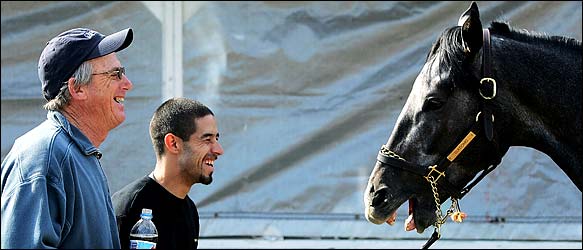
Shirreffs, Herrarte and Giacomo
Giacomo's Trainer Makes Life Changes: "Two days before the Kentucky Derby, John Shirreffs had an experience that would have made his first trip to America's most famous race one to cherish no matter the outcome of the race. As he watched the colt he trained gallop around Churchill Downs for the first time, he was distracted by an equally satisfying thought.
On Giacomo's back was Frankie Herrarte, the gray colt's regular exercise rider who showed up at Shirreffs's barn at Hollywood Park when he was a teenager from the neighborhood, looking for a job. Shirreffs hired him as a hot-walker, and Herrarte proved a good one.
But the boy wanted more. He wanted to learn how to exercise racehorses in the mornings.
Shirreffs taught Herrarte the basics on his own stable pony, and then footed the bill for him to take more advanced lessons. Now there were Shirreffs, 59, and Herrarte, 22, together on horse racing's most hallowed ground.
"John was proud of Frankie, and I was proud of John, and it was a wonderful moment," said Shirreffs's wife, Dottie Ingordo-Shirreffs. "Here was this young man who had never been out of California getting a horse ready for this beautiful, important race. It's what John is about. He treats horses and people as individuals and believes if you do right by both you can change lives."
A nice story about what what most people in sports are really like as opposed to the Sports/Legal section of daily news outlets. The second leg of the triple crown today with The Preakness Stakes in Baltimore, on NBC, post at 6:05 pm ET, so it will run 6:25 or so.
New US Ambassador to the Holy See
The Word From Rome May 20, 2005: "...Francis Rooney, 51, will be the next United States Ambassador to the Holy See.
Under the terms of diplomatic protocol, the Holy See has already given its agreement to the appointment, those sources said. At the moment, the White House is examining Rooney's financial disclosure forms, with a formal announcement of the appointment expected sometime in late May or early June, and Senate hearings shortly thereafter.
Barring a surprise, confirmation is expected to come swiftly.
Rooney, a Catholic, is an Oklahoma native and a graduate of the Georgetown University Law Center. A businessman, he owns Manhattan Construction and Hope Lumber in Tulsa, Okla., and is also CEO of the Florida-based investment firm Rooney Brothers Inc., as well as Rooney Holdings.
Assuming he's confirmed, the posting to the Vatican would be Rooney's first diplomatic assignment. He is not expected to move into the Villa Richardson, the residence of the U.S. ambassador to the Holy See, until late summer or early fall.
Rooney has been an ardent supporter of U.S. President George W. Bush.
Rooney Holdings donated more than $500,000 to the president's re-election campaign in 2004. Data released by the Federal Election Commission on Feb. 7, listed Rooney and his wife Kathleen in fifth place on the list of largest individual donors to political campaigns in the 2004 elections, having distributed $341,396 to various candidates. According to the FEC data, 99 percent of that money went to Republicans.
In 2004, Rooney Holdings contributed $100,000 to "Progress for America," a group promoting the president's Social Security proposals.
In turn, Bush named Rooney to be part of a small delegation led by former U.S. Secretary of State Colin Powell to the August 2004 inauguration of Panamanian President Martin Torrijos. Rooney's construction company does business in Central America, and since 2003 he has served on the advisory board for the Panama Canal.
Rooney's commercial activities have intersected with conservative political causes over the years. Manhattan Construction, for example, built the George Bush Presidential Library in Texas as well as the $6 million headquarters of the Cato Institute, a Washington, D.C.-based think tank with libertarian leanings.
The ambassador's position has been vacant since James Nicholson returned to Washington, D.C., in early 2005 to take up duties as the new Secretary of the Veteran's Administration."
Under the terms of diplomatic protocol, the Holy See has already given its agreement to the appointment, those sources said. At the moment, the White House is examining Rooney's financial disclosure forms, with a formal announcement of the appointment expected sometime in late May or early June, and Senate hearings shortly thereafter.
Barring a surprise, confirmation is expected to come swiftly.
Rooney, a Catholic, is an Oklahoma native and a graduate of the Georgetown University Law Center. A businessman, he owns Manhattan Construction and Hope Lumber in Tulsa, Okla., and is also CEO of the Florida-based investment firm Rooney Brothers Inc., as well as Rooney Holdings.
Assuming he's confirmed, the posting to the Vatican would be Rooney's first diplomatic assignment. He is not expected to move into the Villa Richardson, the residence of the U.S. ambassador to the Holy See, until late summer or early fall.
Rooney has been an ardent supporter of U.S. President George W. Bush.
Rooney Holdings donated more than $500,000 to the president's re-election campaign in 2004. Data released by the Federal Election Commission on Feb. 7, listed Rooney and his wife Kathleen in fifth place on the list of largest individual donors to political campaigns in the 2004 elections, having distributed $341,396 to various candidates. According to the FEC data, 99 percent of that money went to Republicans.
In 2004, Rooney Holdings contributed $100,000 to "Progress for America," a group promoting the president's Social Security proposals.
In turn, Bush named Rooney to be part of a small delegation led by former U.S. Secretary of State Colin Powell to the August 2004 inauguration of Panamanian President Martin Torrijos. Rooney's construction company does business in Central America, and since 2003 he has served on the advisory board for the Panama Canal.
Rooney's commercial activities have intersected with conservative political causes over the years. Manhattan Construction, for example, built the George Bush Presidential Library in Texas as well as the $6 million headquarters of the Cato Institute, a Washington, D.C.-based think tank with libertarian leanings.
The ambassador's position has been vacant since James Nicholson returned to Washington, D.C., in early 2005 to take up duties as the new Secretary of the Veteran's Administration."
Democrats Opposing CAFTA
'New Democrat' Bloc Opposes Trade Pact: "Traditionally pro-business and pro-trade House Democrats have announced plans to vote against the Dominican Republic-Central America Free Trade Agreement, a stance putting at risk support from the rapidly growing high-tech community, one of the few major industries that continue to give substantial backing to Democratic candidates.
The four co-chairmen of the 40-member House New Democrat Coalition have declared their opposition to the agreement, provoking an outcry from high-tech lobbying groups. The opposition is a major setback for the Bush administration, which is struggling to get House and Senate votes on the agreement before the Fourth-of-July congressional recess.
In a letter to the New Democrat Coalition last week, the heads of eight high-tech trade associations wrote: "CAFTA makes important progress in areas critical to the long-term success of our industry, and we consider the vote on this agreement to be one of the most important of 2005. We hope that you will reconsider your opposition."
The four co-chairmen of the 40-member House New Democrat Coalition have declared their opposition to the agreement, provoking an outcry from high-tech lobbying groups. The opposition is a major setback for the Bush administration, which is struggling to get House and Senate votes on the agreement before the Fourth-of-July congressional recess.
In a letter to the New Democrat Coalition last week, the heads of eight high-tech trade associations wrote: "CAFTA makes important progress in areas critical to the long-term success of our industry, and we consider the vote on this agreement to be one of the most important of 2005. We hope that you will reconsider your opposition."
Major Timothy Vakoc: Father Tim
Follow-up on the tribute from President Bush yesterday; from last year in the WSJ: "Maj. H. Timothy Vakoc is a Catholic priest who was serving in Iraq when his Humvee was hit Sunday by a roadside bomb. Maj. Vakoc--Father Tim--... ['s] mere presence [and all] chaplains help remind soldiers, sailors, airmen and Marines of the higher law that obtains even in the thick of war. To put it another way, the chaplain is the unarmed soldier whose job it is to serve those who serve. In a story on chaplains in Iraq published by the National Catholic Register just before he was injured, Maj. Vakoc described this as "the ministry of intentional presence."
In pursuit of this calling, the major has become the first chaplain seriously wounded in Iraq. But he is part of a tradition of distinguished service much larger than himself, one that dates to a year before Independence, when the Continental Congress instituted a chaplain corps for the Army. The memorials at Arlington National Cemetery speak to the many chaplains who have given their lives on the battlefield. A number have even earned the Medal of Honor, including three in Vietnam.
In the age of Michael Moore, the phrase "for God and Country" may be greeted in some quarters with cynicism. But we take the measure of Father Tim and his fellow chaplains by their willingness to put their lives on the line for these words. Where others see a mass of troops, they see individuals with souls and troubles that need tending. As for the risks involved, Father Tim took the chaplains' view: 'The safest place for me to be is in the center of God's Will,' he explained to his sister during a previous deployment to Bosnia, 'and if that is in the line of fire, that is where I will be.'
The cliché has it that there are no atheists in foxholes, which has never been true. The more inspiring reality is that Americans such as Maj. Vakoc, knowing the odds, make those foxholes their ministry."
In pursuit of this calling, the major has become the first chaplain seriously wounded in Iraq. But he is part of a tradition of distinguished service much larger than himself, one that dates to a year before Independence, when the Continental Congress instituted a chaplain corps for the Army. The memorials at Arlington National Cemetery speak to the many chaplains who have given their lives on the battlefield. A number have even earned the Medal of Honor, including three in Vietnam.
In the age of Michael Moore, the phrase "for God and Country" may be greeted in some quarters with cynicism. But we take the measure of Father Tim and his fellow chaplains by their willingness to put their lives on the line for these words. Where others see a mass of troops, they see individuals with souls and troubles that need tending. As for the risks involved, Father Tim took the chaplains' view: 'The safest place for me to be is in the center of God's Will,' he explained to his sister during a previous deployment to Bosnia, 'and if that is in the line of fire, that is where I will be.'
The cliché has it that there are no atheists in foxholes, which has never been true. The more inspiring reality is that Americans such as Maj. Vakoc, knowing the odds, make those foxholes their ministry."
National Catholic Prayer Breakfast

National Catholic Prayer Breakfast

Sister Minereche, Archbishop Chaput, President Bush
President Attends National Catholic Prayer Breakfast: "This morning we also reaffirm that freedom rests on the self-evident truths about human dignity. Pope Benedict XVI recently warned that when we forget these truths, we risk sliding into a dictatorship of relativism where we can no longer defend our values. Catholics and non-Catholics alike can take heart in the man who sits on the chair of St. Peter, because he speaks with affection about the American model of liberty rooted in moral conviction.
This morning we pray for the many Catholics who serve America in the cause of freedom. One of them is an Army Chaplain named Tim Vakoc. He's a beloved priest who was seriously wounded in Iraq last May. We pray for his recovery, we're inspired by his sacrifice. In the finest tradition of American chaplains, he once told his sister, "The safest place for me to be is in the center of God's will, and if that is in the line of fire, that's where I'll be." Father Tim's sister, Anita Brand, and her family, are with us today, and a grateful nation expresses our gratitude to a brave Reverend.
Catholics have made sacrifices throughout American history because they understand that freedom is a divine gift that carries with it serious responsibilities. Among the greatest of these responsibilities is protecting the most vulnerable members of our society. That was the message that Pope John Paul II proclaimed so tirelessly throughout his own life, and it explains the remarkable outpouring of love for His Holiness at the funeral mass that Laura and I were privileged to attend in Rome. It explains why when the men were carrying his wooden casket up the stairs, and they turned to show the casket to the millions that were there, that just as the casket crests, the sun shown for all to see.
The best way to honor this great champion of human freedom is to continue to build a culture of life where the strong protect the weak. So, today, I ask the prayers of all Catholics for America's continued trust in God's purpose, for the wisdom to do what's right, and for the strength and the conviction that so long as America remains faithful to its founding truths, America will always be free."
And from the Washington Post: "For Bush, yesterday's breakfast was an opportunity to thank Catholics, who gave him 52 percent of their votes in November, compared with 47 percent for Sen. John F. Kerry (D-Mass.), a Catholic who supports abortion rights. Bush told the crowd, as he does at all religious events, that he was grateful for their prayers, and he reiterated his support for 'a culture of life' that rejects abortion and euthanasia. 'Pope Benedict XVI recently warned that when we forget these truths, we risk sliding into a dictatorship of relativism, where we can no longer defend our values,' Bush said...
The keynote speaker was Denver Archbishop Charles J. Chaput, who said during the presidential campaign that voting for a candidate who supports abortion rights would be a sin that must be confessed before receiving Holy Communion. 'When a public official claims to be Catholic but then says he can't offer his beliefs about the sanctity of the human person as the basis of law, it always means one of two things: That person is either very confused or he's very evasive,' Chaput told the prayer breakfast. 'All law is the imposition of somebody's beliefs on somebody else.'"
The full text of Archbishop Chaput's remarks are here.
More Hanson in Chicago Tribune: "The Caricature and Reality of George Bush"
"Even when Americans consider that the president's foreign policy might just be working, he is still caricatured by critics and the media, here and abroad, as a clueless Inspector Clouseau who trips around and only stumbles into his good luck. How accurate is that cartoon?
Just imagine if George Bush had predicted to us on the morning after Sept. 11, 2001, what actually ended up happening. He might have delivered the following speech:..."
I encourage reading the rest to see and remember what remarkable events have occured since 9-11. Again, please read it all to understand what all has indeed happened and how fast events move in today's world.
Just imagine if George Bush had predicted to us on the morning after Sept. 11, 2001, what actually ended up happening. He might have delivered the following speech:..."
I encourage reading the rest to see and remember what remarkable events have occured since 9-11. Again, please read it all to understand what all has indeed happened and how fast events move in today's world.
Hanson in NRO: The Two Front War
"Our Two-Front Struggle: Pre-modern Plus Post-modern Equals Riots in Afganistan"Victor Davis Hanson on Europe on National Review Online: "Some Western intellectuals, I think, need a bin Laden to illustrate and confirm their nihilistic ideas about their own postmodern society, just as he needs them to explain why his culture's failure is not its own fault. So just as al Qaeda will always find an enabling Westerner to say, 'You lashed out at us in frustration for your unfair treatment,' so too a guilty Westerner will always find a compliant terrorist to boast, 'Yes, we kill you for your sins.' America was once a country that demolished Hitler and Tojo combined in less than four years and broke the nuclear Soviet Union - and now frets and whines that a few thousand deranged fascists want an apology.
Abroad, we battle Islamic fascists who hate us for our success and want to kill us with the tools of the modern world they despise. But at home, we are also at odds with our own privileged guilt-ridden aristocracy, whose very munificence has made them misunderstand why they are hated.
The Islamists insist, 'We kill you for being soft.' Westerners in response feel, 'We are killed because we are not being soft enough.'
And so they riot and kill in Afghanistan over a stupid rumor, and we seek to apologize that it somehow spread.
How truly sad."
Abroad, we battle Islamic fascists who hate us for our success and want to kill us with the tools of the modern world they despise. But at home, we are also at odds with our own privileged guilt-ridden aristocracy, whose very munificence has made them misunderstand why they are hated.
The Islamists insist, 'We kill you for being soft.' Westerners in response feel, 'We are killed because we are not being soft enough.'
And so they riot and kill in Afghanistan over a stupid rumor, and we seek to apologize that it somehow spread.
How truly sad."
Friday, May 20, 2005
Some EU Results
From MarketWatch this morning: "French GDP rose 0.2% in the first quarter, slower than the 0.5% expected by economists. The data took a shine off share trading on Continental Europe. Fourth-quarter 2004 GDP was revised lower to 0.7% from 0.9%. Italy recently slipped into recession, while Germany posted a surprise 1% rise in first-quarter GDP."
If only more Americans understood world-wide economic performance and how well off we in the US are both politics and investment results would be more satisfactory.
If only more Americans understood world-wide economic performance and how well off we in the US are both politics and investment results would be more satisfactory.
China Bows - Raises Taxes on Textile Exports
Bloomberg.com: Top Worldwide: "China will raise export tariffs on textiles, seeking to avoid U.S. government and European Union limits on shipments of Chinese shirts, trousers and underwear.
China's textile exporters will have to pay a tax of as much as 4 yuan (48 U.S. cents) per item to sell their goods abroad, up from a maximum of 0.3 yuan, the finance ministry said today on its Web site. The new duties, imposed on 74 product types from June 1, are five times higher than previous taxes for most items.
``It's a gesture of goodwill from China,'' said Qu Hongbin, an economist at HSBC Plc in Hong Kong. ``Everything is symbolic because China's exports are very competitive.''
China's plan to raise tariffs ``means that in this little round of arm wrestling that pits the Americans and the Europeans against the Chinese, the Chinese have decided to slow their exports of textile products,'' said Pascal Lamy, nominated on May 13 to be the World Trade Organization's next chief. ``The bottom line is that the Chinese are slowing their exports to avoid the Americans and Europeans slowing their imports,'' the Frenchman said in an interview on the French radio station Europe 1.
Wal-Mart Stores Inc., the world's biggest retailer, said the changes are unlikely to have much effect on its business.
``We did not significantly increase imports from China when the quotas were eliminated,'' Xu Jun, a Wal-Mart spokesman in Beijing. ``Consequently, the re-imposition of tariffs on certain types of apparel will have relatively minimal impact on our business.''
Higher export duties will probably mean European consumers will have to pay more for Chinese garments, said Ralph Kamphoener, a trade adviser at Brussels-based Eurocommerce, which represents 5.3 million retailers.
``An increase in the tax would, of course, have an effect to the detriment of consumers in Europe,'' he said, adding that the EU should consider ``the benefits of trade liberalization for the consumer.'' "
China's textile exporters will have to pay a tax of as much as 4 yuan (48 U.S. cents) per item to sell their goods abroad, up from a maximum of 0.3 yuan, the finance ministry said today on its Web site. The new duties, imposed on 74 product types from June 1, are five times higher than previous taxes for most items.
``It's a gesture of goodwill from China,'' said Qu Hongbin, an economist at HSBC Plc in Hong Kong. ``Everything is symbolic because China's exports are very competitive.''
China's plan to raise tariffs ``means that in this little round of arm wrestling that pits the Americans and the Europeans against the Chinese, the Chinese have decided to slow their exports of textile products,'' said Pascal Lamy, nominated on May 13 to be the World Trade Organization's next chief. ``The bottom line is that the Chinese are slowing their exports to avoid the Americans and Europeans slowing their imports,'' the Frenchman said in an interview on the French radio station Europe 1.
Wal-Mart Stores Inc., the world's biggest retailer, said the changes are unlikely to have much effect on its business.
``We did not significantly increase imports from China when the quotas were eliminated,'' Xu Jun, a Wal-Mart spokesman in Beijing. ``Consequently, the re-imposition of tariffs on certain types of apparel will have relatively minimal impact on our business.''
Higher export duties will probably mean European consumers will have to pay more for Chinese garments, said Ralph Kamphoener, a trade adviser at Brussels-based Eurocommerce, which represents 5.3 million retailers.
``An increase in the tax would, of course, have an effect to the detriment of consumers in Europe,'' he said, adding that the EU should consider ``the benefits of trade liberalization for the consumer.'' "
Yuan Revaluation: Krugman Says Economists Are Confused, Proves With His Confusion
Paul Krugman - The Chinese Connection - New York Times: "Stories about the new Treasury report condemning China's currency policy probably had most readers going, 'Huh?' Frankly, this is an issue that confuses professional economists, too."
And Krugman proves it with his own confused ineptness and hopes for American/Bush economic decline:
"Here's what I think will happen if and when China changes its currency policy, and those cheap loans are no longer available. U.S. interest rates will rise; the housing bubble will probably burst; construction employment and consumer spending will both fall; falling home prices may lead to a wave of bankruptcies. And we'll suddenly wonder why anyone thought financing the budget deficit was easy.In other words, we've developed an addiction to Chinese dollar purchases, and will suffer painful withdrawal symptoms when they come to an end. "
Stay calm, Krugman is confused and his forecast is nonsense. I agree with the editorial in The Economist I cited in a post yesterday: " Don't expect too much." A movement triggered by politics in economics moves slowly, e.g. allowing the yuan to float 2-6% won't cause upheaval in markets nor change employment, balance of payemnts, interest rates very much at all. Events out of policy makers control these days do have the potential for dramatic changes, e.g. 9-11-01.
In all economic situations, Krugman always looks for, predicts, and earnestly hopes for a depression caused by Republicans who are too foolish to just raise income taxes, sales taxes, payroll taxes, corporate taxes and use any tool to grab any assets in the hands of any entity not in poverty.
Come September the NYT wants us to pay $50 per year for access to columns like this? That new business model may need more work.
And Krugman proves it with his own confused ineptness and hopes for American/Bush economic decline:
"Here's what I think will happen if and when China changes its currency policy, and those cheap loans are no longer available. U.S. interest rates will rise; the housing bubble will probably burst; construction employment and consumer spending will both fall; falling home prices may lead to a wave of bankruptcies. And we'll suddenly wonder why anyone thought financing the budget deficit was easy.In other words, we've developed an addiction to Chinese dollar purchases, and will suffer painful withdrawal symptoms when they come to an end. "
Stay calm, Krugman is confused and his forecast is nonsense. I agree with the editorial in The Economist I cited in a post yesterday: " Don't expect too much." A movement triggered by politics in economics moves slowly, e.g. allowing the yuan to float 2-6% won't cause upheaval in markets nor change employment, balance of payemnts, interest rates very much at all. Events out of policy makers control these days do have the potential for dramatic changes, e.g. 9-11-01.
In all economic situations, Krugman always looks for, predicts, and earnestly hopes for a depression caused by Republicans who are too foolish to just raise income taxes, sales taxes, payroll taxes, corporate taxes and use any tool to grab any assets in the hands of any entity not in poverty.
Come September the NYT wants us to pay $50 per year for access to columns like this? That new business model may need more work.
Thursday, May 19, 2005
CEO of Time Warner on Social Security
The following is from an editorial by Richard Parsons, the current Chairman and CEO of Time Warner, and a co-chair of President Bush's Commission to Strengthen Social Security: Chicago Tribune A real opportunity to fix Social Security: "If you look at any major newspaper today, you're likely to read conflicting views on what the future holds for Social Security. As my commission co-chair, the late Daniel Patrick Moynihan, put it, 'You're entitled to your own opinion. You are not entitled to your own set of facts.'
So let's look at the facts. In 1950, there were 16 workers supporting every retiree in Social Security's pay-as-you-go financing system. That meant taxes were relatively low.
Today, there are roughly three workers supporting each retiree, thus a higher tax burden per worker. By 2030, there will be only two workers for each retiree. This downward trend in the ratio of workers to retirees will inexorably require painful tax increases or significant benefit cuts or astronomical levels of borrowing. In a worst-case scenario, it might require all three.
Looking this problem squarely in the eye--something politicians have been reluctant to do for decades--Bush has put a bold plan on the table.
His reform proposal would ensure that benefits for low-income workers, those who depend on Social Security the most, would grow faster than benefits for people who are better off. By most accounts, this reform would solve 70 percent of the funding deficit facing Social Security.
At the same time, the president believes, and I agree, that giving workers the voluntary choice of investing in a personal retirement account--in addition to patching that hole in the Social Security safety net--will provide millions of current and future workers with the nest eggs they'll need to live in comfort once they retire.
Pat Moynihan and I agreed that this is not a debate about the success of the current Social Security system. Few would disagree that it has been a reliable source of income for 70 years that has virtually eliminated poverty among the elderly. Rather, this is a debate about how to structure a system that is fair and makes sense to today's young people.
If you asked Americans under 40 today what kind of public pension system they would create if we were starting from scratch, an overwhelming majority of them would tell you that a personal retirement account should figure prominently in the new system. Sadly, the voices of these younger Americans are not well represented in the debate today because there is no well-heeled interest group speaking for them.
Bush understands that personal retirement accounts are not a magical solution to all the fiscal woes facing Social Security. But by coupling that choice with a real plan to put the system's solvency on solid footing, I believe he has given us the first real chance in decades to say to current and future retirees, "The benefits you have been promised will be there when you need them."
The late Sen. Moynihan was both a loyal Democrat and a tried-and-true realist who recognized that there were problems that no one party could solve. He believed that by acting together and by favoring facts over theories, we could fix Social Security before it was beset by crisis. We need that same faith today."
So let's look at the facts. In 1950, there were 16 workers supporting every retiree in Social Security's pay-as-you-go financing system. That meant taxes were relatively low.
Today, there are roughly three workers supporting each retiree, thus a higher tax burden per worker. By 2030, there will be only two workers for each retiree. This downward trend in the ratio of workers to retirees will inexorably require painful tax increases or significant benefit cuts or astronomical levels of borrowing. In a worst-case scenario, it might require all three.
Looking this problem squarely in the eye--something politicians have been reluctant to do for decades--Bush has put a bold plan on the table.
His reform proposal would ensure that benefits for low-income workers, those who depend on Social Security the most, would grow faster than benefits for people who are better off. By most accounts, this reform would solve 70 percent of the funding deficit facing Social Security.
At the same time, the president believes, and I agree, that giving workers the voluntary choice of investing in a personal retirement account--in addition to patching that hole in the Social Security safety net--will provide millions of current and future workers with the nest eggs they'll need to live in comfort once they retire.
Pat Moynihan and I agreed that this is not a debate about the success of the current Social Security system. Few would disagree that it has been a reliable source of income for 70 years that has virtually eliminated poverty among the elderly. Rather, this is a debate about how to structure a system that is fair and makes sense to today's young people.
If you asked Americans under 40 today what kind of public pension system they would create if we were starting from scratch, an overwhelming majority of them would tell you that a personal retirement account should figure prominently in the new system. Sadly, the voices of these younger Americans are not well represented in the debate today because there is no well-heeled interest group speaking for them.
Bush understands that personal retirement accounts are not a magical solution to all the fiscal woes facing Social Security. But by coupling that choice with a real plan to put the system's solvency on solid footing, I believe he has given us the first real chance in decades to say to current and future retirees, "The benefits you have been promised will be there when you need them."
The late Sen. Moynihan was both a loyal Democrat and a tried-and-true realist who recognized that there were problems that no one party could solve. He believed that by acting together and by favoring facts over theories, we could fix Social Security before it was beset by crisis. We need that same faith today."
The Economist on Yuan Revaluation
Economist.com China's currency: "...even if China does revalue, it will not be the salvation that American politicians are praying for. First, it is highly unlikely that the yuan will be allowed to rise very far; even optimists expect a revaluation only in the range of 3-10%, which will still leave the currency seriously undervalued.
Moreover, the effects of a relaxed peg on America's current-account deficit will be extremely modest. China accounts for less than one-tenth of America's trade, so even a 10% revaluation would only reduce the trade-weighted value of the dollar by 1%-not enough to produce any noticeable change in America's current account. Nor is it clear that even a big revaluation would help much. Morris Goldstein of the Institute for International Economics estimates that even a 25% revaluation would reduce the current-account deficit by less than 5%.
Nonetheless, China seems to be preparing the way for a slightly freer currency. This week it allowed some foreign currencies to be traded against each other for the first time in China. This is widely seen as a preparation for reform of the tightly controlled currency regime. And if a revaluation seems unlikely to please America's protectionist politicians, it should nonetheless help to correct the imbalances caused by the gaping American current-account deficit, if only by weaning America's spendthrift consumers-and government-off cheap Chinese credit. If the hour of reckoning is not quite at hand, it seems only a matter of time before China's financial system, and America's borrowers, begin to grow up."
Moreover, the effects of a relaxed peg on America's current-account deficit will be extremely modest. China accounts for less than one-tenth of America's trade, so even a 10% revaluation would only reduce the trade-weighted value of the dollar by 1%-not enough to produce any noticeable change in America's current account. Nor is it clear that even a big revaluation would help much. Morris Goldstein of the Institute for International Economics estimates that even a 25% revaluation would reduce the current-account deficit by less than 5%.
Nonetheless, China seems to be preparing the way for a slightly freer currency. This week it allowed some foreign currencies to be traded against each other for the first time in China. This is widely seen as a preparation for reform of the tightly controlled currency regime. And if a revaluation seems unlikely to please America's protectionist politicians, it should nonetheless help to correct the imbalances caused by the gaping American current-account deficit, if only by weaning America's spendthrift consumers-and government-off cheap Chinese credit. If the hour of reckoning is not quite at hand, it seems only a matter of time before China's financial system, and America's borrowers, begin to grow up."
Dean v. Russert
From Bob Novak : "...anticipation of Howard Dean, cut loose and unmuzzled, on 'Meet the Press' Sunday is unsettling for the party's faithful. This will be his first exposure as chairman on a major network interview, and Russert predictably will be well prepared with a rap sheet of the chairman's verbal assaults. The prospect that Dean will make juicy additions to that collection unnerves Democrats."
***********
Bob handily goes through a run-down of Chairman/Gov./Dr. Dean's faux pas. I can say Bob because I have had drinks with Novak and his wife after an ACC basketball tournament game in a USAir Club. It was G&Ts all around and they were, and I'm sure are, very nice people in person. Novak is a huge Maryland fan and I'm with Wake.
***********
Bob handily goes through a run-down of Chairman/Gov./Dr. Dean's faux pas. I can say Bob because I have had drinks with Novak and his wife after an ACC basketball tournament game in a USAir Club. It was G&Ts all around and they were, and I'm sure are, very nice people in person. Novak is a huge Maryland fan and I'm with Wake.
Wednesday, May 18, 2005
Blawgs
Legal Affairs:The Supreme Court recently made history by citing a blog. Called "Sentencing Law and Policy," it's a year-old web log by Douglas Berman, a professor of law at Ohio State University (http://sentencing.typepad.com). Berman's is among the best law blogs in the country, though not the best known. That may be "The Volokh Conspiracy," a three-year-old group effort featuring conservative views that is led by UCLA law professor Eugene Volokh (http://volokh.com). Or it may be "Underneath Their Robes," launched last summer by the anonymous A3G (Article III Groupie), who says her blog is about her "obsession" with federal judges, which extends to her picking Manhattan trial judge Kimba Wood as the hottest one (http://underneaththeirrobes.blogs.com). Or it may be "How Appealing," the three-year-old blog specializing in appellate law, written by a Philadelphia lawyer named Howard Bashman and so respected that I'd mention it even if it weren't hosted by this magazine (http://legalaffairs.org/howappealing).
"A BLAWG,...: a blog about the law. Most blawgers are law professors, lawyers, or law students and, reading what they post online, you realize that they're not the uncredentialed challenging credentialed journalists, but credentialed lawyers (or lawyers-in-the-making) endeavoring to take back their subject from journalists and talking heads. While much of their content is gossip, a lot is commentary geared toward legal experts and virtually impenetrable for anyone else. Rather than being a populist advance, blawgs are often outlets for rarefied material...
You can herald blawgs as providing analysis, information, and opinion in a new form. You can dismiss some as a way for people with tenure and a lofty opinion of themselves to have their say in yet another forum. However you slot them, the impulse to blog often seems to be the opposite of the effect of blawgs. The key ones are efforts by lawyers and academics to be public voices, to matter outside the legal world, to connect. Yet while blawgs are blogs, they rarely have the populist touch that is supposed to make blogs blogs." {via Instapundit.}
************
So sometimes I'm a blawger. The headline might be that I'm starting law school this August so then my blog will more officially become a real blawg.
"A BLAWG,...: a blog about the law. Most blawgers are law professors, lawyers, or law students and, reading what they post online, you realize that they're not the uncredentialed challenging credentialed journalists, but credentialed lawyers (or lawyers-in-the-making) endeavoring to take back their subject from journalists and talking heads. While much of their content is gossip, a lot is commentary geared toward legal experts and virtually impenetrable for anyone else. Rather than being a populist advance, blawgs are often outlets for rarefied material...
You can herald blawgs as providing analysis, information, and opinion in a new form. You can dismiss some as a way for people with tenure and a lofty opinion of themselves to have their say in yet another forum. However you slot them, the impulse to blog often seems to be the opposite of the effect of blawgs. The key ones are efforts by lawyers and academics to be public voices, to matter outside the legal world, to connect. Yet while blawgs are blogs, they rarely have the populist touch that is supposed to make blogs blogs." {via Instapundit.}
************
So sometimes I'm a blawger. The headline might be that I'm starting law school this August so then my blog will more officially become a real blawg.
Tuesday, May 17, 2005
Arnold Palmer: Commencement Address at WFU

WFU Commencement 2005
Arnold Palmer: "Certainly, there are many things that I cannot fully comprehend, but there are still the absolutes that transcend place and time:
Hard work will always yield positive results.
Be fully aware of the world around you.
Act purposefully on your strongest perceptions, and then with no regrets.
Don't pass up opportunities that you perceive to be something of a gamble. I ran across a brief essay on that subject by a Chicago school teacher, who said: 'Risks must be taken, because the greatest hazard in life is to risk nothing. The person who risks nothing, does nothing, has nothing, IS nothing. They may avoid suffering and sorrow, but they cannot learn, feel, change, grow, love and live.'
Or, as Bill Gates once said on a similar occasion as this: 'Life is not fair. Get used to it. The world won't care about your self-esteem. The world will expect you to accomplish something before you feel good about yourself. If you mess up, don't whine about your mistakes. Learn from them. Life is not divided into semesters. You don't get summers off, and few employers are interested in helping you find yourself. Do that on your own time.'
Once I was talking about improving one's golf game, but it struck me afterward that what I had just said applies to life as well. I'm talking about self-confidence. There is no way you can focus your mind and your efforts to succeed if you're brimming over with self-doubts. Your level of performance has a way of living up to prior expectations and, if you start off believing you're going to have a bad day, you will. Errors tend to multiply and, if you have a bundle of self-doubts, you won't be able to cope with the problems and the failure that will follow...
...I don't despair of today's young people. I just ask all of you to seek your places in the world, to accept the responsibility that is being placed on your shoulders. I appeal to you to try to restore a more kind and gentle atmosphere to this world of ours. Greed should not be our goal. If we continue to tolerate cheating, stealing, lying and violence, we will be on a path to self-destruction. Only through an all-out effort to get back to the basic values and virtues of humanity can we give future generations the quality of life our forefathers worked and sacrificed for to give us the standards of life we now enjoy in our time.
Family, friends, neighbors, home, church and community used to be vitally important to most Americans. Perhaps it's time to return to some of those core values.
You will soon be assuming parental roles, and I urge you to accept the responsibility that goes with it. Be the kind of parents who teach your children the basic traits and habits that make good citizens and good human beings. Teach them the common courtesies, good manners, politeness, and standards of behavior that will make each and every one of you proud.
So, please, go forth from your college careers armed with a determination to truly make our world a better place to live.
Tomorrow belongs to you."
Monday, May 16, 2005
The Yuan: Wal-Mart's Currency Hedge Strategy

Dollar Doldrums
Dollar Doldrums - CFO Magazine - May Issue 2005: "Consider Wal-Mart, arguably the U.S. company most heavily exposed to a run on the dollar. China is the discount retailer's largest source of products, supplying some $20 billion in goods last year, according to analysts. The company plans to increase U.S. borrowings in 2005, says Jay Fitzsimmons, Wal-Mart's treasurer and senior vice president of finance, though he contends it's not for purposes of hedging, since the Chinese currency is linked to the dollar.
In any case, says Fitzsimmons, "we try to do as much as we can naturally." Natural hedges include setting aside cash and borrowing in local currencies such as sterling, yen, and Canadian dollars. But Fitzsimmons says the company will probably borrow about $5.5 billion to $6 billion by year's end, up from about $1 billion so far this year. Its total debt portfolio currently weighs in at around $30 billion, including everything from public bond issues to commercial paper.
Like other companies, Wal-Mart has natural alternatives to hedging with debt, including diversification, thanks to retail operations in 10 different countries. "On one level, our retail operations portfolio contains a mix of emerging markets and more-established markets," notes Fitzsimmons. Two of Wal-Mart's largest markets—Canada and Mexico—recently saw their currencies actually fall against the U.S. dollar. (The company's 37.8 percent interest in a Japanese retail outlet, Seiyu Ltd., is accounted for as an equity investment, and is not consolidated.)
Also, Wal-Mart tries to get what Fitzsimmons describes as the "lowest possible margin commensurate with the risk" in its purchasing and retailing arrangements. As a result, he says, "the actual impact of currency on the merchandise we buy is minimal." The company buys very little from Europe. As for the risk posed by the Chinese yuan, he contends it is undervalued versus the dollar by about 4 percent, noting that "5 percent is kind of the margin of error."
Because of this, Fitzsimmons dismissed dire predictions that the Chinese government will wreak havoc on his bottom line by abruptly jettisoning its currency's link to the greenback. "We buy everything in dollars," he says. "The Chinese aren't interested in getting more yuan. Their number-one priority is keeping people employed."
Tougher US Voter Requirements
"To begin, we have much too much democracy. We need to discourage people from voting. In fact, the gravest obstacle to the restoration of civilization in North America is universal suffrage. Letting everybody vote makes no sense. Obviously they are no good at it. The whole idea smacks of the fumble-witted idealism of a high-school Marxist society. At least eighty percent of the electorate lives in blank medieval darkness regarding any matter of public policy or history. They might as well vote on the incisions needed in cardiac surgery as try to govern themselves. Poll after poll shows that even graduates of America's pathetic...universities, which means most of the universities, do not know who fought in WWI, or within a century when the Civil War took place, or who Galileo was. These are the better informed. The rest barely know what century they live in. Unalloyed ignorance is not an obvious qualification for governing, despite all appearances." --Fred Reed
Also from The Federalist Patriot 05-20 Brief.
The trick would be to have standards and yet avoid discrimination and disenfranchisement. I would support as a condition to vote a requirement that all citizens pass the same citizenship test we require for all immigrants to pass in order to become naturalized US citizens.
Also from The Federalist Patriot 05-20 Brief.
The trick would be to have standards and yet avoid discrimination and disenfranchisement. I would support as a condition to vote a requirement that all citizens pass the same citizenship test we require for all immigrants to pass in order to become naturalized US citizens.
Memo to Sen. John Edwards on Poverty
"Avoiding long-term poverty is not rocket science. First, graduate from high school. Second, get married before you have children, and stay married. Third, work at any kind of job, even one that starts out paying the minimum wage. And, finally, avoid engaging in criminal behavior. If you graduate from high school today with a B or C average, in most places in our country there's a low-cost or financially assisted post-high-school education program available to increase your skills. Most jobs start with wages higher than the minimum wage, which is currently $5.15. A man and his wife, even earning the minimum wage, would earn $21,000 annually. According to the Bureau of Census, in 2003, the poverty threshold for one person was $9,393, for a two-person household it was $12,015, and for a family of four it was $18,810. Taking a minimum-wage job is no great shakes, but it produces an income higher than the Bureau of Census' poverty threshold. Plus, having a job in the first place increases one's prospects for a better job." --Walter Williams
Courtesy of The Federalist Patriot 05-20 Brief.
Courtesy of The Federalist Patriot 05-20 Brief.
Sunday, May 15, 2005
Robert Kagan: "The Illusion of 'Managing' China"
The Illusion of 'Managing' China: "The United States may not be able to avoid a policy of containing China; we are, in fact, already doing so. This is a sufficiently unsettling prospect, however, that we are doing all we can to avoid thinking about it. We conjure hopeful images of a modernizing China that seeks only economic growth and would do nothing to threaten commercial ties with us -- unless provoked -- even as we watch nervously the small but steady Chinese military buildup, the periodic eruptions of popular nationalism, the signs of Chinese confidence intermingled with feelings of historical injustice and the desire to right old wrongs.
Which China is it? A 21st-century power that wants to be integrated into a liberal international order, which would mean both a transformation of its own polity and a limitation of its strategic ambitions? Or a 19th-century power that wants to preserve its rule at home and expand its reach abroad? It is a worthy subject for debate, because the answer will determine the future as much as or more than anything we do. But it is unlikely we will have a definitive answer in time to adjust, to "manage" China's "rise," any more than our predecessors did. As in the past, we will have to peer into the fog and make prudent judgments, informed by the many tragic lessons of history."
Which China is it? A 21st-century power that wants to be integrated into a liberal international order, which would mean both a transformation of its own polity and a limitation of its strategic ambitions? Or a 19th-century power that wants to preserve its rule at home and expand its reach abroad? It is a worthy subject for debate, because the answer will determine the future as much as or more than anything we do. But it is unlikely we will have a definitive answer in time to adjust, to "manage" China's "rise," any more than our predecessors did. As in the past, we will have to peer into the fog and make prudent judgments, informed by the many tragic lessons of history."
"Guaranteed Collisions"
George Will - Guaranteed Collisions: "The public sector's problems with retirees are about to become more visible. The GASB, which writes accounting rules for state and local governments, is going to require them to reveal the cash value of their retirees' health care entitlements. Janice Revell, writing in the May 2 issue of Fortune, notes that when such rules were applied to corporations, in 1990, revealing huge health care liabilities, Wall Street blanched. So, between 1993 and 2003, the percentage of companies offering medical coverage to retirees plummeted from 40 percent to 21 percent...
The public sector is facing similar pressures. All but two states, and a majority of municipalities, have increasingly crushing legacy costs because they provide health care to their retired workers. Buffalo, Revell writes, pays $26 million a year -- equal to a fifth of property tax revenue -- for such benefits. After just five years on the job, any North Carolina state employee is eligible for free retiree health insurance for life, and the GASB's new accounting rules will reportedly add a $13 billion liability to the state's books -- about 40 times the state's annual retiree health care costs."
The public sector is facing similar pressures. All but two states, and a majority of municipalities, have increasingly crushing legacy costs because they provide health care to their retired workers. Buffalo, Revell writes, pays $26 million a year -- equal to a fifth of property tax revenue -- for such benefits. After just five years on the job, any North Carolina state employee is eligible for free retiree health insurance for life, and the GASB's new accounting rules will reportedly add a $13 billion liability to the state's books -- about 40 times the state's annual retiree health care costs."
Saturday, May 14, 2005
"College Libraries Set Aside Books in a Digital Age"
New York Times: "Students attending the University of Texas at Austin will find something missing from the undergraduate library this fall. Books.
By mid-July, the university says, almost all of the library's 90,000 volumes will be dispersed to other university collections to clear space for a 24-hour electronic information commons, a fast-spreading phenomenon that is transforming research and study on campuses around the country.
"In this information-seeking America, I can't think of anyone who would elect to build a books-only library," said Fred Heath, vice provost of the University of Texas Libraries in Austin.
"There's a real transition going on," said Sarah Thomas, past president of the Association of Research Libraries and the librarian at the Cornell University Library in Ithaca, N.Y. "This is not to say you don't have paper or books. Of course, they're sacred. But more and more we're delivering material to the user as opposed to the user coming into the library to get it."
This is a new generation, born with a chip," said Frances Maloy, president of the Association of College and Research Libraries and leader of access services at Emory. "A student sends an e-mail at 2 a.m. and wonders by 8 a.m. why the professor hasn't responded."
By mid-July, the university says, almost all of the library's 90,000 volumes will be dispersed to other university collections to clear space for a 24-hour electronic information commons, a fast-spreading phenomenon that is transforming research and study on campuses around the country.
"In this information-seeking America, I can't think of anyone who would elect to build a books-only library," said Fred Heath, vice provost of the University of Texas Libraries in Austin.
"There's a real transition going on," said Sarah Thomas, past president of the Association of Research Libraries and the librarian at the Cornell University Library in Ithaca, N.Y. "This is not to say you don't have paper or books. Of course, they're sacred. But more and more we're delivering material to the user as opposed to the user coming into the library to get it."
This is a new generation, born with a chip," said Frances Maloy, president of the Association of College and Research Libraries and leader of access services at Emory. "A student sends an e-mail at 2 a.m. and wonders by 8 a.m. why the professor hasn't responded."
Friday, May 13, 2005
Clinton, Gingrich on Health Care
USATODAY.com - Former foes Clinton, Gingrich band up on health care plan: "Sen. Hillary Rodham Clinton detected a hint of 'cognitive dissonance' Wednesday as she stood next to onetime political enemy Newt Gingrich to help unveil a bill to 'transform' the health care system.
The 21st Century Health Information Act would replace paperwork with confidential, electronic health information networks designed to save lives and money by eliminating medical errors.
"I know it's a bit of an odd fellow, or odd woman, mix," Clinton joked, "but speaker Gingrich and I have been talking about health care and national security for several years."
A member of the Senate Armed Services Committee, Clinton noted the two also serve together on a military advisory panel. She recalled the reaction after they agreed at its first meeting. "People thought, 'The end is near.' It's a sign of the end times," she said with a grin. "But I think it's just a sign that we can come together and try to solve a real problem for America."
The 21st Century Health Information Act would replace paperwork with confidential, electronic health information networks designed to save lives and money by eliminating medical errors.
"I know it's a bit of an odd fellow, or odd woman, mix," Clinton joked, "but speaker Gingrich and I have been talking about health care and national security for several years."
A member of the Senate Armed Services Committee, Clinton noted the two also serve together on a military advisory panel. She recalled the reaction after they agreed at its first meeting. "People thought, 'The end is near.' It's a sign of the end times," she said with a grin. "But I think it's just a sign that we can come together and try to solve a real problem for America."
N.C. Judge Boyle's US 4th Circuit Nomination Saga & Why Nominees Endure Wait: ($)
N.C. Judge Has Spent 15 Years as A Nominee: "The Senate Judiciary Committee's schedule says today is the day for a vote on President Bush's nomination of Terrence W. Boyle to the U.S. Court of Appeals for the 4th Circuit. Then again, the Republican-controlled committee may put it off to deal with other judicial nominees and unrelated business; it has done so twice this year already. And so it goes in Boyle's bid for a seat on the federal appellate bench -- a nearly 15-year saga whose end is nowhere in sight.
Boyle, a favorite of former senator Jesse Helms (R-N.C.), has been a controversial candidate ever since President George H.W. Bush tried and failed in 1991 to put him on the Richmond-based 4th Circuit.
The issue then was not Boyle's record. Rather, he got caught up in the ill will generated by the Senate's just-concluded battle over Bush's nomination of Clarence Thomas to the Supreme Court.
If Boyle is confirmed, he would have a strong incentive to serve full time for only a few years.
He is eligible to retire and continue to receive his full salary (currently $171,800 for a circuit judge) for life when he turns 65 in 2010. Or he could become a senior judge that year, earning a full salary while handling a quarter of an active judge's caseload.
In either scenario, the president would have to name a replacement, with the advice and consent of the Senate."
Boyle, a favorite of former senator Jesse Helms (R-N.C.), has been a controversial candidate ever since President George H.W. Bush tried and failed in 1991 to put him on the Richmond-based 4th Circuit.
The issue then was not Boyle's record. Rather, he got caught up in the ill will generated by the Senate's just-concluded battle over Bush's nomination of Clarence Thomas to the Supreme Court.
If Boyle is confirmed, he would have a strong incentive to serve full time for only a few years.
He is eligible to retire and continue to receive his full salary (currently $171,800 for a circuit judge) for life when he turns 65 in 2010. Or he could become a senior judge that year, earning a full salary while handling a quarter of an active judge's caseload.
In either scenario, the president would have to name a replacement, with the advice and consent of the Senate."
CAFTA
newsobserver.com: "CAFTA, has also garnered support from an unlikely coalition of textile companies, farmers and food processors who see opportunity in the countries covered by the deal.
Between 2001 and 2004, North Carolina exports to the countries covered -- Costa Rica, the Dominican Republic, El Salvador, Guatemala, Honduras and Nicaragua -- grew by $678 million, the largest gain of any state, U.S. Department of Commerce data shows. The $1.7 billion worth of manufactured goods that the state sold to those nations last year makes North Carolina the region's third-largest trade partner, after Texas and Florida.
Allen Gant, president of Glen Raven, however, is among North Carolina textile makers who believe CAFTA will help safeguard what's left of the country's fabric industry. With the lifting of quotas on Chinese textile products this year, competition from that country has intensified. A trade accord with Central America will allow Gant's factories in Glen Raven, High Point and Norlina to continue to export fabric to factories in Central America that cut and sew it into clothes for exports back to the United States, he said.
Without it, Gant said, textile imports from low-cost countries in Asia will gradually erode production in the United States as well as in Central America. For the U.S. textile industry to survive, "there has to be an easy, efficient and competitive way to turn it into garment," Gant said.
The Bush administration recently promised to change language in CAFTA to protect exports of pocketing and lining material from the United States to Central America. On Monday, that prompted the trade group that Gant leads, the National Council of Textile Organizations, to endorse CAFTA. "
*****************
Again, I am a strong free-trade advocate with protection to retrain and support the unemployed. One disclosure, Mr. Gant's sister sat beside me in a lot of undergraduate classes in the last century.
Between 2001 and 2004, North Carolina exports to the countries covered -- Costa Rica, the Dominican Republic, El Salvador, Guatemala, Honduras and Nicaragua -- grew by $678 million, the largest gain of any state, U.S. Department of Commerce data shows. The $1.7 billion worth of manufactured goods that the state sold to those nations last year makes North Carolina the region's third-largest trade partner, after Texas and Florida.
Allen Gant, president of Glen Raven, however, is among North Carolina textile makers who believe CAFTA will help safeguard what's left of the country's fabric industry. With the lifting of quotas on Chinese textile products this year, competition from that country has intensified. A trade accord with Central America will allow Gant's factories in Glen Raven, High Point and Norlina to continue to export fabric to factories in Central America that cut and sew it into clothes for exports back to the United States, he said.
Without it, Gant said, textile imports from low-cost countries in Asia will gradually erode production in the United States as well as in Central America. For the U.S. textile industry to survive, "there has to be an easy, efficient and competitive way to turn it into garment," Gant said.
The Bush administration recently promised to change language in CAFTA to protect exports of pocketing and lining material from the United States to Central America. On Monday, that prompted the trade group that Gant leads, the National Council of Textile Organizations, to endorse CAFTA. "
*****************
Again, I am a strong free-trade advocate with protection to retrain and support the unemployed. One disclosure, Mr. Gant's sister sat beside me in a lot of undergraduate classes in the last century.
Thursday, May 12, 2005
Why the Chinese “Yaun” is not a “Sleeper” Issue

Chinese Yuan
And How the Price of a Tee Shirt Controls a Nuclear North Korea
I contend that the most serious long range issue faced by the United States both in foreign affairs and in economics is the exponential emergence of China as an economic engine with the power to influence and control future world-wide events. We all recall the past years when the world’s tension (the Cold War) was focused on the two superpowers of the USA and the USSR. While I do not discount the importance of the Middle East in terms of terrorism, religious conflict, violence and oil disruptions; the rise of India as one of great powers; the importance of all of Asia (Japan, the Korean peninsula, Taiwan vis-à-vis China, Vietnam); the EU (consolidation and decline) and the changes in NATO; the evolution of Russia; and the turmoil in South America – none of these compare in scope and importance to the rise of China as the balancing superpower to the United States.
Economists and businessmen recognized this first and have been writing, talking, and acting upon these realities for some time. The foreign affairs gurus are catching up and even the popular press (Newsweek last week) is starting to recognize the size of the issue.
The two superpowers will engage in a race to economic preeminence which I see as a potentially great and positive change agent for the entire world, albeit that all change is inherently stressful and fraught with dangers. I do not see the rise of China into a more democratic, energy consuming, and modern country as a problem but rather as a challenge – chance for a win-win for China and the USA rather than a win for only one. The US must resist foolish protectionist thinking and resistance to change, and accommodations in thoughts and attitudes will be required by all the citizens of the world. The strength of most institutions in both countries (primarily those focused on education, technology, and the public and private support structures to provide safety nets to those whose abilities to adapt are too slow for the speed of change) will be immensely challenged.
This on-going economic race will create many diplomatic and military challenges but I see the key to the smoothness of the race to be forward-thinking, free-market, and democracy-based economic policy. Foreign affairs policies and the internal and international economic policies employed by the two main superpowers and the supporting players throughout the world will by necessity have to be fast-moving, far-sighted, and engaged without fear.
To bring all of this back to ground, the current movement of the Chinese yuan is a unique glimpse of the impact of economic policies upon current events in the world today.
(If you need background just remember that the value of a currency is essentially its price - usually measured by how much it costs to buy or sell, e.g. an ounce of gold buys $100 dollars or $1 is worth 8 yuan, etc. When a currency is pegged at a certain value such as China pegging its yuan against the dollar at a set price, the currency does not move on a free market basis but is controlled by actions of a country’s central bank to control the price at the set number. These actions include heavy foreign buying of US debt instruments such as Treasury bills that some short thinkers worry weakens the fiscal strength of the US as more US debt is held by foreign hands rather than US hands. In reality global economies are so interdependent and the US is so credit-worthy in the eyes of the world this is not yet a problem. This description is very simplistic but let’s leave it there for now.)
China has pegged the yuan at an artificial value that for China creates cheap exports and grows its own economy at a rapid pace, maintains and grows employment, energy consumption (think oil) and higher standards of living. The US would prefer to improve our own balance of payments (reduce trade deficits) by allowing our goods to be more attractive in foreign markets and imported goods more dear (expensive) thus improving and strengthening our economy (think US manufacturing) and holding jobs.
The US and China have conflicting goals. The US and China also recognize a need to compromise to create as much of a win-win as possible to help each other succeed as reasonable for both.
To further simplify the connections between economics, politics, and foreign affairs: The model I am asking you to consider is that as the US encourages China to allow the Yuan to float 2-6% in the near term rather than forcing a harsher correction upon China the US is in better position to encourage China to put greater pressure upon the North Koreans to negotiate in good faith toward a resolution of the nuclear threat in the Korean Peninsula. Therefore the price of tee shirts in Wal-Mart that are all imports from China should begin to go up about 5% (still cheaper than a US tee shirt which is not a bad thing given the theory of comparative advantage – another day’s topic) and we should see China get North Korea back to the bargaining table over nuclear weapons in the not too distant future. Of course, the flaw in the theory is that Kim Jung Il is not always a rational actor.
So watch the price of tee shirts to predict nuclear proliferation.
Trade Deficit Shrinks
Exports boom, drop in imports boost economy: "A record surge in exports and an unexpected falloff in imports in March enabled the economy to grow faster than previously thought last winter -- at a 4 percent rate or higher instead of 3 percent.
That is the conclusion of economists after the Commerce Department yesterday reported an unexpected 9.2 percent drop in the monthly trade deficit to $55 billion, the lowest in a half year. The surge in exports was fueled by aircraft sales, while the decline in imports was fed by a tailing off of Chinese textile imports.
...Although some economists might interpret March's downshift in demand for imports as evidence the economy is softening, Mr. Gonzalez said it largely reflects the winding down of a surge of imported clothing from China that started at the beginning of the year when quotas were lifted.
Imports from China fell 4.4 percent, led by a 21.2 percent drop in clothing and textiles.
Under pressure from textile and furniture manufacturers losing market share to China, the U.S. Congress and Bush administration have stepped up pressure on China to stop fixing its currency against the dollar and let it rise in the open market.
"The U.S. dollar is still 7 percent higher against foreign currencies than it was when it started its run-up eight years ago," said Mr. Vargo.[VP of National Association of Manufacturers] "The dollar has adjusted nicely against European, Canadian and some other market currencies, but has been prevented from adjusting against Asian currencies because governments there continue to intervene."
*****************
Recall my forecast in The Anderson Papers on 01-02-05 where I predicted a US GDP growth rate for 2005 of 4.25%. I remain confident in that prediction here in the middle of month five. I think various events are containing the Fed's fears (and mine) over inflationary pressure and hence the FOMC will allow the US economy to grow at the rate I forecast and that I hope comes to fruition.
That is the conclusion of economists after the Commerce Department yesterday reported an unexpected 9.2 percent drop in the monthly trade deficit to $55 billion, the lowest in a half year. The surge in exports was fueled by aircraft sales, while the decline in imports was fed by a tailing off of Chinese textile imports.
...Although some economists might interpret March's downshift in demand for imports as evidence the economy is softening, Mr. Gonzalez said it largely reflects the winding down of a surge of imported clothing from China that started at the beginning of the year when quotas were lifted.
Imports from China fell 4.4 percent, led by a 21.2 percent drop in clothing and textiles.
Under pressure from textile and furniture manufacturers losing market share to China, the U.S. Congress and Bush administration have stepped up pressure on China to stop fixing its currency against the dollar and let it rise in the open market.
"The U.S. dollar is still 7 percent higher against foreign currencies than it was when it started its run-up eight years ago," said Mr. Vargo.[VP of National Association of Manufacturers] "The dollar has adjusted nicely against European, Canadian and some other market currencies, but has been prevented from adjusting against Asian currencies because governments there continue to intervene."
*****************
Recall my forecast in The Anderson Papers on 01-02-05 where I predicted a US GDP growth rate for 2005 of 4.25%. I remain confident in that prediction here in the middle of month five. I think various events are containing the Fed's fears (and mine) over inflationary pressure and hence the FOMC will allow the US economy to grow at the rate I forecast and that I hope comes to fruition.
China Denies Yuan Revaluation Imminent
China said to deny official report implying yuan shift: "TOKYO (MarketWatch) -- No sooner did the English online edition of China's official People's Daily say Wednesday that a shift in policy on yuan revaluation was near than central bank officials reportedly denied the content of the report, leaving investors no wiser about the timing of China's widely expected currency reform.
The report, which was apparently removed from the newspaper's Web site, said that the country would loosen its renminbi yuan's fixed-exchange rate next week.
The yuan, which is now effectively pegged at about 8.28 to the dollar, will be allowed to rise or fall from 1.26% to 6.03% in a span of one month and one year after a meeting between U.S. and Chinese officials, the report had said.
But People's Bank of China spokesmen denied China's central bank has any plans to adjust the currency next week, according to several media reports.
A report Wednesday morning in Japan's main business newspaper implied China is ready to act on currency reform anytime but is taking its time.
People's Bank of China Deputy Governor Wu Xiaoling said the central bank is now "technically" prepared to carry out currency reforms. But in an interview with the Nihon Keizai Shimbun, she criticized the U.S. for pressuring China to implement currency reforms and for calling for the expansion of the currency band."
The report, which was apparently removed from the newspaper's Web site, said that the country would loosen its renminbi yuan's fixed-exchange rate next week.
The yuan, which is now effectively pegged at about 8.28 to the dollar, will be allowed to rise or fall from 1.26% to 6.03% in a span of one month and one year after a meeting between U.S. and Chinese officials, the report had said.
But People's Bank of China spokesmen denied China's central bank has any plans to adjust the currency next week, according to several media reports.
A report Wednesday morning in Japan's main business newspaper implied China is ready to act on currency reform anytime but is taking its time.
People's Bank of China Deputy Governor Wu Xiaoling said the central bank is now "technically" prepared to carry out currency reforms. But in an interview with the Nihon Keizai Shimbun, she criticized the U.S. for pressuring China to implement currency reforms and for calling for the expansion of the currency band."
Kaus on Diamond-Orszag Plan
Let's Not Save Social Security - Once it's fixed, we can't fix it again!: "The most frequently cited Democratic alternative plan is the one proposed by Peter Diamond and Peter Orszag--call it the Two Peters Plan. They estimate the total 75 year Social Security shortfall at 1.9 percent of taxable payroll, and would meet it by a combination of tax increases and benefit cuts...
In addition to the benefit cuts outline above, Diamond and Orszag have the current 12.4 percent Social Security payroll tax rising to 15.4 percent in 2078 and continuing to rise "slowly over time thereafter." Even if the Medicare tax is kept at its current 2.9 percent (a seeming impossibility) that means total FICA payroll taxes in excess of 18%. You want to try to finance universal health care on top of that? I don't...
Nobody--neither the President, nor Pozen, nor the Democrats--is talking about radically reducing the size of the program, Australia style. They're all talking about saving a program that consumes somewhere from 12 to 17 percent of the national payroll. Once its financial imbalance is solved it will be virtually impossible to restructure... Before they stabilize the system at this high level of GDP consumption--cementing it in place,in effect--Democrats may want time to think about whether they want to devote such a large part of society's resources to a universal check-mailing scheme. My guess is Democrats will need at least some of those GDP points for health care. It will be easier to get them if Social Security is still perceived as a progam in need of reform, as opposed to a program that got fixed back in 2005."
In addition to the benefit cuts outline above, Diamond and Orszag have the current 12.4 percent Social Security payroll tax rising to 15.4 percent in 2078 and continuing to rise "slowly over time thereafter." Even if the Medicare tax is kept at its current 2.9 percent (a seeming impossibility) that means total FICA payroll taxes in excess of 18%. You want to try to finance universal health care on top of that? I don't...
Nobody--neither the President, nor Pozen, nor the Democrats--is talking about radically reducing the size of the program, Australia style. They're all talking about saving a program that consumes somewhere from 12 to 17 percent of the national payroll. Once its financial imbalance is solved it will be virtually impossible to restructure... Before they stabilize the system at this high level of GDP consumption--cementing it in place,in effect--Democrats may want time to think about whether they want to devote such a large part of society's resources to a universal check-mailing scheme. My guess is Democrats will need at least some of those GDP points for health care. It will be easier to get them if Social Security is still perceived as a progam in need of reform, as opposed to a program that got fixed back in 2005."
Democrats' Diamond-Orszag SocSec Reform Plan
Stanley Kurtz on Social Security: "The Democrats actually do have a plan to save Social Security. Their proposal was authored by MIT economist Peter Diamond and Brookings Institute fellow Peter Orszag...Diamond-Orszag resembles the president's plan in that it proposes substantial reductions in the rate at which Social Security benefits increase. Diamond-Orszag's benefit "cuts" (really lower benefit increases) are smaller and more progressive than the "cuts" proposed by the president. Yet Diamond-Orszag pays for these smaller cuts with a substantial tax increase.
Once you see the Democrats' plan to save Social Security, several things become clear. First, Social Security is in serious trouble. Even the Democrats can't save it without painful changes. Second, the Democrats' own proposal shows that any realistic plan to save Social Security requires benefit cuts. The president's plan makes up 70 percent of the Social Security revenue shortfall through benefit cuts. The Democrats' plan makes up 50 percent of that shortfall through broadly similar cuts. It's tough to indict the president for callous indifference to the plight of retirees when we're talking about a 20-percent difference between two plans. Third, the Democrats' proposal shows that the real alternative to benefit cuts is a major tax increase. In short, once the public knows what the Democrats' plan actually says, it will quickly become impossible to use Social Security as a hammer against the Republicans."
Once you see the Democrats' plan to save Social Security, several things become clear. First, Social Security is in serious trouble. Even the Democrats can't save it without painful changes. Second, the Democrats' own proposal shows that any realistic plan to save Social Security requires benefit cuts. The president's plan makes up 70 percent of the Social Security revenue shortfall through benefit cuts. The Democrats' plan makes up 50 percent of that shortfall through broadly similar cuts. It's tough to indict the president for callous indifference to the plight of retirees when we're talking about a 20-percent difference between two plans. Third, the Democrats' proposal shows that the real alternative to benefit cuts is a major tax increase. In short, once the public knows what the Democrats' plan actually says, it will quickly become impossible to use Social Security as a hammer against the Republicans."
Wednesday, May 11, 2005
Roses in Georgia
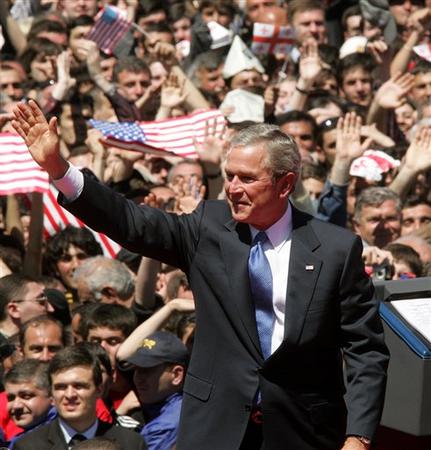
President Bush in Tbilisi, Georgia
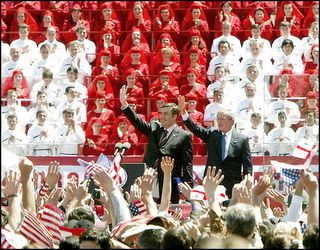
President Bush & Georgia's President Mikheil Saakashvili
My Way News: "TBILISI, Georgia (AP) - President Bush, before a cheering crowd of tens of thousands of people, said Tuesday that the former Soviet republic of Georgia is proving to the world that determined people can rise up and claim their freedom from oppressive rulers.
'Your courage is inspiring democratic reformers and sending a message that echoes across the world: Freedom will be the future of every nation and every people on Earth,' Bush said in speech from the Freedom Square that symbolizes the city's democratic pursuits. 'You gathered here armed with nothing but roses and the power of your convictions and you claimed your liberty. And because you acted, Georgia is today both sovereign and free and a beacon of liberty for this region and the world.'
Georgian President Mikhail Saakashvili said it was by far the largest gathering in the country since its independence, and it was certainly one of the largest Bush has ever addressed. Saakashvili, who led the Rose Revolution in 2003 that overthrew a corrupt government, praised Bush as "a leader who has contributed as much to the cause of freedom as any man of our time. ... We welcome a freedom fighter."
"You stood with us during our revolution and you stand with us today," Saakashvili said. "On behalf of my nation I would like to say, 'Thank you.'"
Roger Kimball: "Retaking the Universities"
OpinionJournal - Extra: "It is a peculiar moment in academia. In many ways, things have never been worse. All those radical trends that got going in the 1960s and gained steam in the 1970s and 1980s are now so thoroughly entrenched that they are simply taken for granted.
The chief issue is this: Should our institutions of higher education be devoted primarily to the education of citizens--or should they be laboratories for social and political experimentation?
Since the 1960s, however, colleges and universities have more and more been home to what Lionel Trilling called the "adversary culture of the intellectuals." The goal was less reflection than rejection. The English novelist Kingsley Amis once observed that much of what was wrong with the 20th century could be summed up in the word "workshop." Nowadays, "workshop" has been largely replaced by the word "studies." Gender Studies, Ethnic Studies, Afro-American Studies, Women's Studies, Gay, Lesbian and Transgender Studies: These are not the names of academic disciplines but political grievances. They exist not to further liberal education but to nurture the feckless antinomianism that Jacques Barzun dubbed "directionless quibble.
The use and abuse of academic freedom to indemnify not the expression of unpopular opinions but political incitement of various kinds is one symptom of the degradation of American academic life.
Academics have an unspoken compact with society. As scholars, their charge is to pursue the truth in their chosen discipline; as teachers, their charge is to help preserve and transmit the truth by encouraging thoughtful study and candid discussion. The largely unspoken nature of this compact was part of its glory--it underscored the element of freedom that has always been a central ingredient in liberal education. To a large extent, that freedom has been violated. "
The chief issue is this: Should our institutions of higher education be devoted primarily to the education of citizens--or should they be laboratories for social and political experimentation?
Since the 1960s, however, colleges and universities have more and more been home to what Lionel Trilling called the "adversary culture of the intellectuals." The goal was less reflection than rejection. The English novelist Kingsley Amis once observed that much of what was wrong with the 20th century could be summed up in the word "workshop." Nowadays, "workshop" has been largely replaced by the word "studies." Gender Studies, Ethnic Studies, Afro-American Studies, Women's Studies, Gay, Lesbian and Transgender Studies: These are not the names of academic disciplines but political grievances. They exist not to further liberal education but to nurture the feckless antinomianism that Jacques Barzun dubbed "directionless quibble.
The use and abuse of academic freedom to indemnify not the expression of unpopular opinions but political incitement of various kinds is one symptom of the degradation of American academic life.
Academics have an unspoken compact with society. As scholars, their charge is to pursue the truth in their chosen discipline; as teachers, their charge is to help preserve and transmit the truth by encouraging thoughtful study and candid discussion. The largely unspoken nature of this compact was part of its glory--it underscored the element of freedom that has always been a central ingredient in liberal education. To a large extent, that freedom has been violated. "
Tuesday, May 10, 2005
Update on China's Peg to US Dollar
In today's MarketWatch morning email - Before the Bell:
"Investors waiting for China to loosen its renminbi yuan's peg to the dollar got a hint Tuesday that such a move might not be forthcoming, when a Chinese government bureau warned of the consequences of such a move. China's National Bureau of Statistics said that a 15% appreciation of the yuan "would turn China's export growth negative this year," according to a research report posted on the bureau's Web site, AFX-Asia reported. The bureau forecast that a more moderate revaluation of 3.0% to 5.0% would lead to export growth falling this year to less than 10.0%, compared with last year's growth of 35.4%. "
********
The importance of this speaks to those worried about encroaching Chinese imports and to those worried about the amount of US Securities held by foreign investors, particularly Asian central banks and especially China. I am not worried about either but watch developments closely.
MarketWatch is a great free service for all types of financial and business research. A free subscription to Before the Bell is available here.
"Investors waiting for China to loosen its renminbi yuan's peg to the dollar got a hint Tuesday that such a move might not be forthcoming, when a Chinese government bureau warned of the consequences of such a move. China's National Bureau of Statistics said that a 15% appreciation of the yuan "would turn China's export growth negative this year," according to a research report posted on the bureau's Web site, AFX-Asia reported. The bureau forecast that a more moderate revaluation of 3.0% to 5.0% would lead to export growth falling this year to less than 10.0%, compared with last year's growth of 35.4%. "
********
The importance of this speaks to those worried about encroaching Chinese imports and to those worried about the amount of US Securities held by foreign investors, particularly Asian central banks and especially China. I am not worried about either but watch developments closely.
MarketWatch is a great free service for all types of financial and business research. A free subscription to Before the Bell is available here.
Monday, May 09, 2005
How Michael Moore Made $21 Million
Paranoia for Fun and Profit - How Disney and Michael Moore cleaned up on Fahrenheit 9/11. By Edward Jay-Epstein:
"On the Fahrenheit 9/11 DVD, Moore says he resolved to get the film seen in America 'by hook or by crook.' His hook was censorship.
On May 5, 2004, the New York Times ran a front-page article headlined 'Disney Is Blocking Distribution of Film That Criticizes Bush.' The story included the sensational charge that Eisner 'expressed particular concern that [choosing to distribute Fahrenheit 9/11] would endanger tax breaks Disney receives for its theme park, hotels and other ventures in Florida, where Mr. Bush's brother, Jeb, is governor.' The source for this allegation was Moore's agent, Ari Emanuel. Two days later, Moore claimed on his Web site that Disney's board of directors rejected Fahrenheit 9/11 'last week.' In fact, the Disney board had not made such a decision in 2004 - the project had been vetoed in 2003.
Moore's excursion from reality proved a boon at Cannes. On May 22, 2004, the Cannes jury defied putative efforts to censor Moore by awarding Fahrenheit 9/11 the prestigious Palme d'Or. Moore now had a golden palm in his hand and the media at his feet - with more free publicity than any Hollywood studio could afford to buy, Fahrenheit 9/11 now stood to rake in a fortune...
Under normal circumstances, documentaries rarely, if ever, make profits (especially if distributors charge the usual 33 percent fee). So, when Miramax made the deal for Fahrenheit 9/11, it allowed Moore a generous profit participation—which turned out to be 27 percent of the film's net receipts. Disney, in honoring this deal, paid Moore a stunning $21 million. Moore never disclosed the amount of his profit participation. When asked about it, the proletarian Moore joked to reporters on a conference call, "I don't read the contracts."
...Michael Moore had perhaps the happiest ending of all. Not only had he made $21 million, he already had a sequel in preproduction—Fahrenheit 9/11 ½."
"On the Fahrenheit 9/11 DVD, Moore says he resolved to get the film seen in America 'by hook or by crook.' His hook was censorship.
On May 5, 2004, the New York Times ran a front-page article headlined 'Disney Is Blocking Distribution of Film That Criticizes Bush.' The story included the sensational charge that Eisner 'expressed particular concern that [choosing to distribute Fahrenheit 9/11] would endanger tax breaks Disney receives for its theme park, hotels and other ventures in Florida, where Mr. Bush's brother, Jeb, is governor.' The source for this allegation was Moore's agent, Ari Emanuel. Two days later, Moore claimed on his Web site that Disney's board of directors rejected Fahrenheit 9/11 'last week.' In fact, the Disney board had not made such a decision in 2004 - the project had been vetoed in 2003.
Moore's excursion from reality proved a boon at Cannes. On May 22, 2004, the Cannes jury defied putative efforts to censor Moore by awarding Fahrenheit 9/11 the prestigious Palme d'Or. Moore now had a golden palm in his hand and the media at his feet - with more free publicity than any Hollywood studio could afford to buy, Fahrenheit 9/11 now stood to rake in a fortune...
Under normal circumstances, documentaries rarely, if ever, make profits (especially if distributors charge the usual 33 percent fee). So, when Miramax made the deal for Fahrenheit 9/11, it allowed Moore a generous profit participation—which turned out to be 27 percent of the film's net receipts. Disney, in honoring this deal, paid Moore a stunning $21 million. Moore never disclosed the amount of his profit participation. When asked about it, the proletarian Moore joked to reporters on a conference call, "I don't read the contracts."
...Michael Moore had perhaps the happiest ending of all. Not only had he made $21 million, he already had a sequel in preproduction—Fahrenheit 9/11 ½."
Sunday, May 08, 2005
David McCullough: "Knowing History and Knowing Who We Are"
Whenever I think of the current political and economic situation of our nation and our world I am very reassured by our history. One of my favorite quotes, attributed to Paul Harvey: "In times like these it helps to recall that there have always been times like these."
From a February 2005 speech given by David McCullough, historian, prize winning author, and a man whose work has been a great joy to me: Hillsdale College:
"Now those who wrote the Declaration of Independence in Philadelphia that fateful summer of 1776 were not superhuman by any means. Every single one had his flaws, his failings, his weaknesses. Some of them ardently disliked others of them. Every one of them did things in his life he regretted. But the fact that they could rise to the occasion as they did, these imperfect human beings, and do what they did is also, of course, a testimony to their humanity. We are not just known by our failings, by our weaknesses, by our sins. We are known by being capable of rising to the occasion and exhibiting not just a sense of direction, but strength...
Keep in mind that when we were founded by those people in the late 18th century, none of them had had any prior experience in either revolutions or nation-making. They were, as we would say, winging it. And they were idealistic and they were young. We see their faces in the old paintings done later in their lives or looking at us from the money in our wallets, and we see the awkward teeth and the powdered hair, and we think of them as elder statesmen. But George Washington, when he took command of the continental army at Cambridge in 1775, was 43 years old, and he was the oldest of them. Jefferson was 33 when he wrote the Declaration of Independence. John Adams was 40. Benjamin Rush – one of the most interesting of them all and one of the founders of the antislavery movement in Philadelphia – was 30 years old when he signed the Declaration. They were young people. They were feeling their way, improvising, trying to do what would work. They had no money, no navy, no real army. There wasn’t a bank in the entire country. There wasn’t but one bridge between New York and Boston. It was a little country of 2,500,000 people, 500,000 of whom were held in slavery, a little fringe of settlement along the east coast. What a story. What a noble beginning. And think of this: almost no nations in the world know when they were born. We know exactly when we began and why we began and who did it...
The Revolutionary War was as dark a time as we’ve ever been through. 1776, the year we so consistently and rightly celebrate every year, was one of the darkest times, if not the darkest time in the history of the country. Many of us here remember the first months of 1942 after Pearl Harbor when German submarines were sinking our oil tankers right off the coasts of Florida and New Jersey, in sight of the beaches, and there wasn’t a thing we could do about it. Our recruits were drilling with wooden rifles, we had no air force, half of our navy had been destroyed at Pearl Harbor, and there was nothing to say or guarantee that the Nazi machine could be defeated – nothing. Who was to know? I like to think of what Churchill said when he crossed the Atlantic after Pearl Harbor and gave a magnificent speech. He said we haven’t journeyed this far because we’re made of sugar candy. It’s as true today as it ever was."
***********
Read this speech for the thoughtfulness, brevity and impact. On a larger scale, take the time to read history through David McCullough's eyes. McCullough's next book, 1776, is to be published in May 2005. I can't wait.
Happy Mother's Day!
From a February 2005 speech given by David McCullough, historian, prize winning author, and a man whose work has been a great joy to me: Hillsdale College:
"Now those who wrote the Declaration of Independence in Philadelphia that fateful summer of 1776 were not superhuman by any means. Every single one had his flaws, his failings, his weaknesses. Some of them ardently disliked others of them. Every one of them did things in his life he regretted. But the fact that they could rise to the occasion as they did, these imperfect human beings, and do what they did is also, of course, a testimony to their humanity. We are not just known by our failings, by our weaknesses, by our sins. We are known by being capable of rising to the occasion and exhibiting not just a sense of direction, but strength...
Keep in mind that when we were founded by those people in the late 18th century, none of them had had any prior experience in either revolutions or nation-making. They were, as we would say, winging it. And they were idealistic and they were young. We see their faces in the old paintings done later in their lives or looking at us from the money in our wallets, and we see the awkward teeth and the powdered hair, and we think of them as elder statesmen. But George Washington, when he took command of the continental army at Cambridge in 1775, was 43 years old, and he was the oldest of them. Jefferson was 33 when he wrote the Declaration of Independence. John Adams was 40. Benjamin Rush – one of the most interesting of them all and one of the founders of the antislavery movement in Philadelphia – was 30 years old when he signed the Declaration. They were young people. They were feeling their way, improvising, trying to do what would work. They had no money, no navy, no real army. There wasn’t a bank in the entire country. There wasn’t but one bridge between New York and Boston. It was a little country of 2,500,000 people, 500,000 of whom were held in slavery, a little fringe of settlement along the east coast. What a story. What a noble beginning. And think of this: almost no nations in the world know when they were born. We know exactly when we began and why we began and who did it...
The Revolutionary War was as dark a time as we’ve ever been through. 1776, the year we so consistently and rightly celebrate every year, was one of the darkest times, if not the darkest time in the history of the country. Many of us here remember the first months of 1942 after Pearl Harbor when German submarines were sinking our oil tankers right off the coasts of Florida and New Jersey, in sight of the beaches, and there wasn’t a thing we could do about it. Our recruits were drilling with wooden rifles, we had no air force, half of our navy had been destroyed at Pearl Harbor, and there was nothing to say or guarantee that the Nazi machine could be defeated – nothing. Who was to know? I like to think of what Churchill said when he crossed the Atlantic after Pearl Harbor and gave a magnificent speech. He said we haven’t journeyed this far because we’re made of sugar candy. It’s as true today as it ever was."
***********
Read this speech for the thoughtfulness, brevity and impact. On a larger scale, take the time to read history through David McCullough's eyes. McCullough's next book, 1776, is to be published in May 2005. I can't wait.
Happy Mother's Day!
Subscribe to:
Posts (Atom)